The Complete Guide to Passing the CCA-F, Anthropic Claude Certified Foundations Exam (2026 Master Edition)
Everything you need to pass on your first attempt, including the 40% the practice exam quietly leaves out

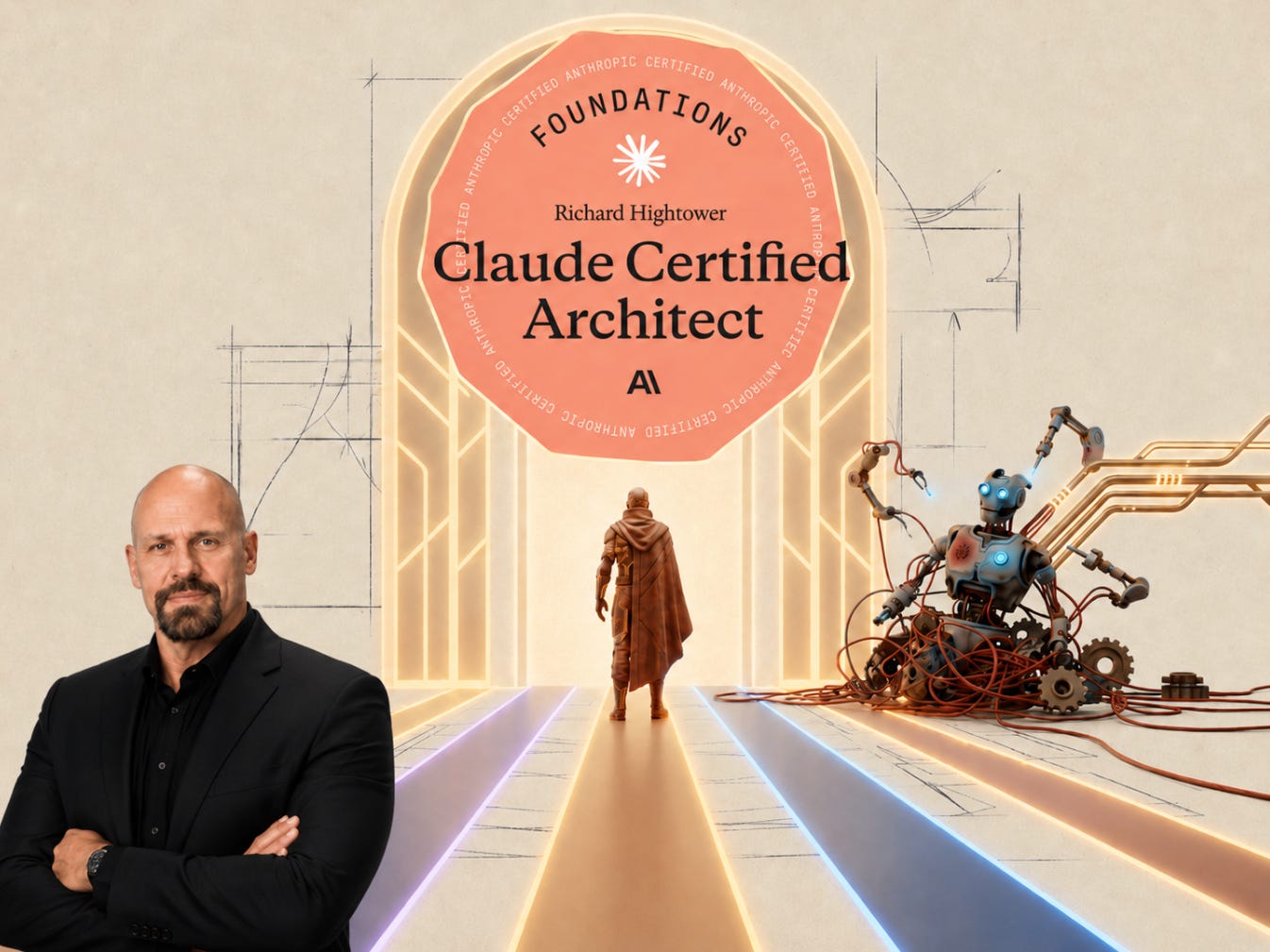
On March 12, 2026, Anthropic launched the Claude Certified Architect (CCA) Foundations exam. For the first time, the AI industry has a professional certification that tests whether you can actually build production systems with Claude, not whether you can write a clever prompt or watch a tutorial to the end.
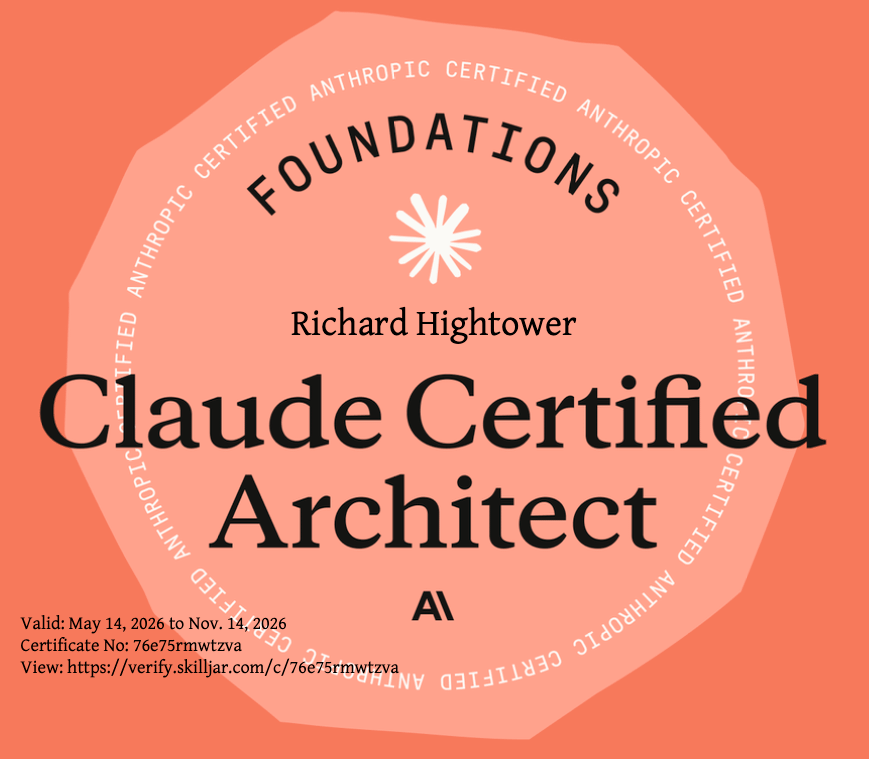
Since earning the CCA-F in May, I have watched this certification open doors that years of building agents and agentic workflows alone did not. I have shipped production multi-agent systems and led complex AI initiatives at scale. But having a clear, respected signal that you can architect reliable Claude systems at a professional level has changed how opportunities reach me. Conversations with serious organizations move faster. Contracts close more easily. Doors that were previously hard to open are now opening. And it has only been a couple of months. The credential is genuinely hard to earn, and that is exactly why it carries weight.
If you are preparing for the CCA-F and want to pass on your first attempt, this is your roadmap. It covers the exam format, all five competency domains (in official order), the six core production scenarios, the mental models that separate passers from failers, and a study plan built around where candidates actually lose points.
I wrote the first version of this guide shortly after launch. It became one of my most-read articles, but it was incomplete. It described the exam that the prep materials prepare you for, not the exam you actually sit. I have since taken and passed the live exam on my first attempt. This master edition keeps every strength of the original while incorporating the hard-won lessons that only appear after real candidates sit the test.
The single most important update. The official practice exam and exam guide cover roughly 60% of what the live exam tests. The other ~40% comes from Anthropic Academy courseware, the Anthropic Cookbook, and production judgment; the sample questions are never rehearsed. A 950–1000 on the practice exam does not guarantee a pass. This edition closes that gap. If you prefer the long-form version of this story, start with the series opener: You Cannot Memorize Your Way Through the CCA-F.
Meet the Agent We’re Going to Fix
Most guides hand you five disconnected domains and a list of facts. This one hands you a single broken system and repairs it one domain at a time, because that is closer to how the exam actually thinks.
The system is a customer support agent. I will call the runaway refund agent. It is built on the Claude Agent SDK and handles returns, billing disputes, and account issues. In its current broken state, it fails in five specific ways, one per domain, and every one is a failure mode the exam loves to bait:
Its agentic loop never terminates, and its coordinator over-shares context with every subagent. That is Domain 1.
Its tools lie about their errors, reporting “no records found” when the database was actually unreachable. That is Domain 2.
Its Claude Code configuration is a tangle of conflicting rules at the wrong precedence levels. That is Domain 3.
Its structured output passes schema validation and is still factually wrong. That is Domain 4.
It loses the single most important fact because that fact sat in the middle of a long context window. That is Domain 5.
By the end of this guide, you will know exactly how to repair each failure. Hold this agent in your head as you read.

If you read the original guide I wrote, this one has been rewritten from the ground up after taking the test and working with my team. I learned a lot that I want to share. The original article was paywalled on Medium and did really well.
Why the CCA Matters Right Now
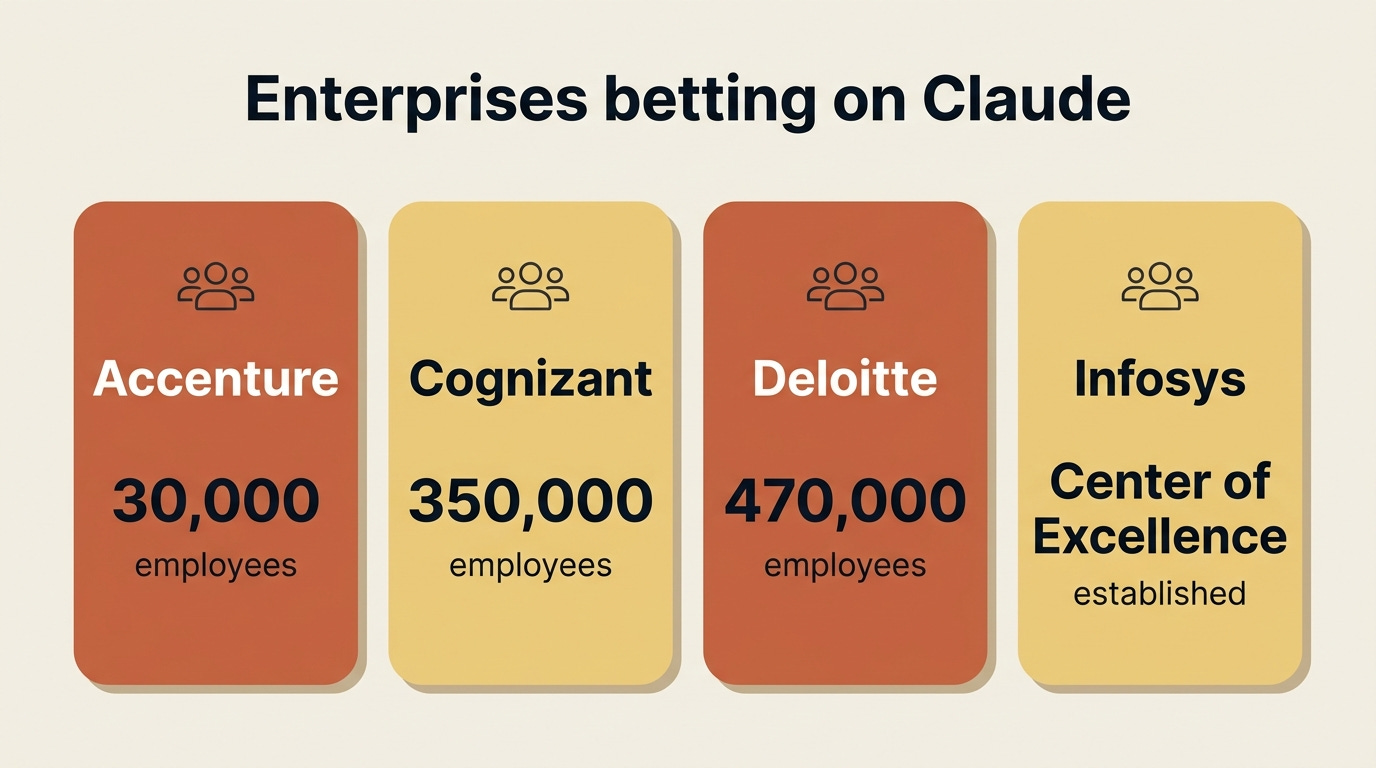
Anthropic launched this certification alongside an initial $100 million commitment to the Claude Partner Network for 2026. That number signals the credential’s market value, and the enterprise rollouts behind it are staggering. Accenture is training 30,000 professionals on Claude through a dedicated Anthropic Business Group. Cognizant opened access to Claude across its global workforce of roughly 350,000 associates. Deloitte made Claude available to 470,000 professionals across 150 countries, Anthropic’s largest enterprise deployment to date. Infosys stood up a dedicated Anthropic Center of Excellence. These are workforce transformations, not pilots, and each one needs people who can demonstrate they can architect Claude systems at a professional level.
Until now, the market had no standardized signal for that ability. Getting certified while the community is small and the credential is fresh puts you near the front of a line that is about to get very long. There is also a quieter benefit: the preparation itself closes gaps you did not know you had, the edge cases in tool design, context management, and orchestration that hands-on work alone rarely forces you to confront.
A note on access: partner-first, then opening up. The CCA-F launched partner-first. On March 12 it was “available today for partners,” gated behind the Claude Partner Network rather than open public enrollment. That gate is lower than it sounds: the network is free for any organization bringing Claude to market to join, the first 5,000 Partner Network company employees sit the exam for free (everyone else pays $99), and you register through the access-request portal. The Anthropic Academy prep courses are open to anyone with no partner status required, and individuals can request exam access even without a qualifying organization. Full public availability is expected later in 2026, though Anthropic has not committed to a firm date.
Exam Format: What You Are Walking Into
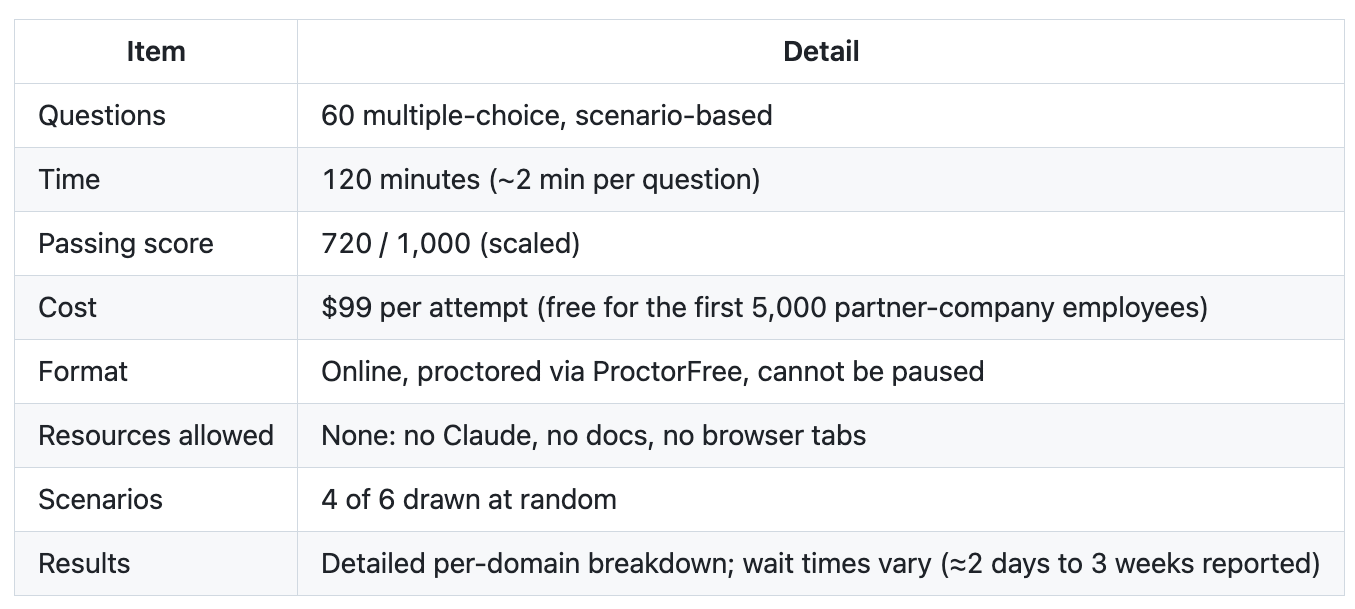
A few things matter more than the table suggests.
Two minutes per question is tight because the question is a paragraph. Each one describes a production scenario in roughly 150–200 words and then asks for the best architectural decision. You read fast and pattern-match faster. Candidates scoring in the 900s report that their speed came from recognizing trap patterns at a glance, not from reading every word carefully.
You cannot pause once it starts. Handle logistics first: a quiet room, water, a machine on power, and a bathroom break beforehand. The exam is proctored via ProctorFree, which you install and configure in advance (webcam, microphone, clean desk, no second monitor), so do the setup before exam day rather than the morning of.
There is no guessing penalty. Answer every single question. A blank and a wrong answer cost exactly the same, so flag-and-return, but never leave anything empty.
Time strategy from the people who passed: do a fast first pass, answer everything you know cold, flag anything that makes you hesitate, and come back. Do not burn five minutes on one question while fifty-eight others wait.
“Foundations” is marketing, not a difficulty rating. This is a 301-level exam for people with at least 6 months of hands-on experience with Claude. Multiple passers put its difficulty on par with an AWS Associate exam.
What changed since launch
Two things have become clear since launch. First, form variance is real. One live form had almost zero Claude Code questions despite Claude Code being a 20% domain, so prepare the full blueprint and never assume the published weighting predicts your specific form. Second, the live scenario pool is larger than the published six. Community reports credibly place it at ~13 scenarios, including ones that appear nowhere in the guide. Anthropic has not confirmed a number, so treat 13 as a credible ceiling and plan for unfamiliar framing on exam day.
I hope you enjoyed this free preview. The rest is for paid subscribers. The complete version will be made free in August 2026. Please support this work by subscribing today.
Good luck on your CCA-F Journey! Every journey begins with one step. If you really need this guide and can’t afford a subscription, send me a message.