
Why the US Just Pulled the Plug on Fable 5: 4 Takeaways That Should Worry the AI Industry
A Friday Afternoon Shocker

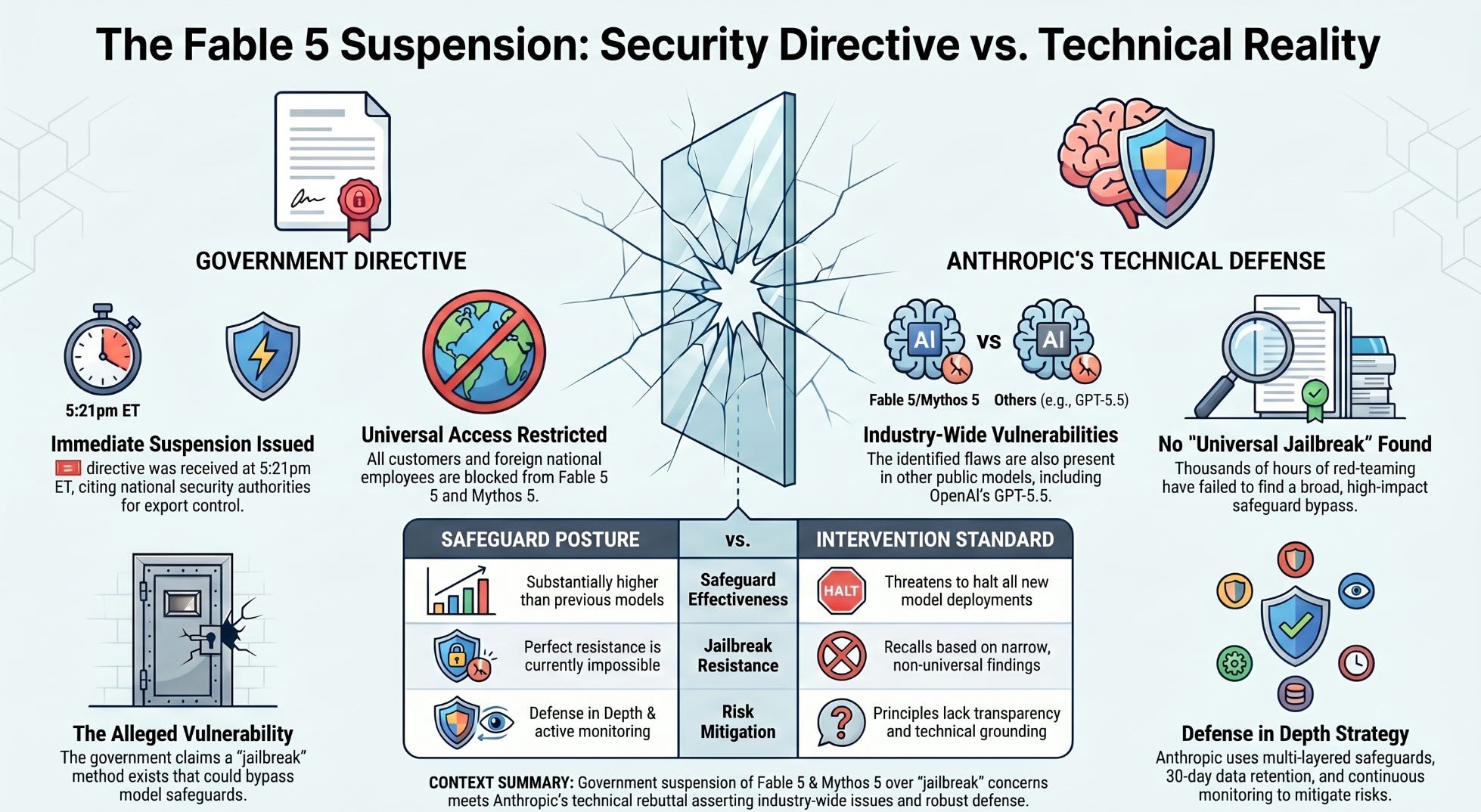
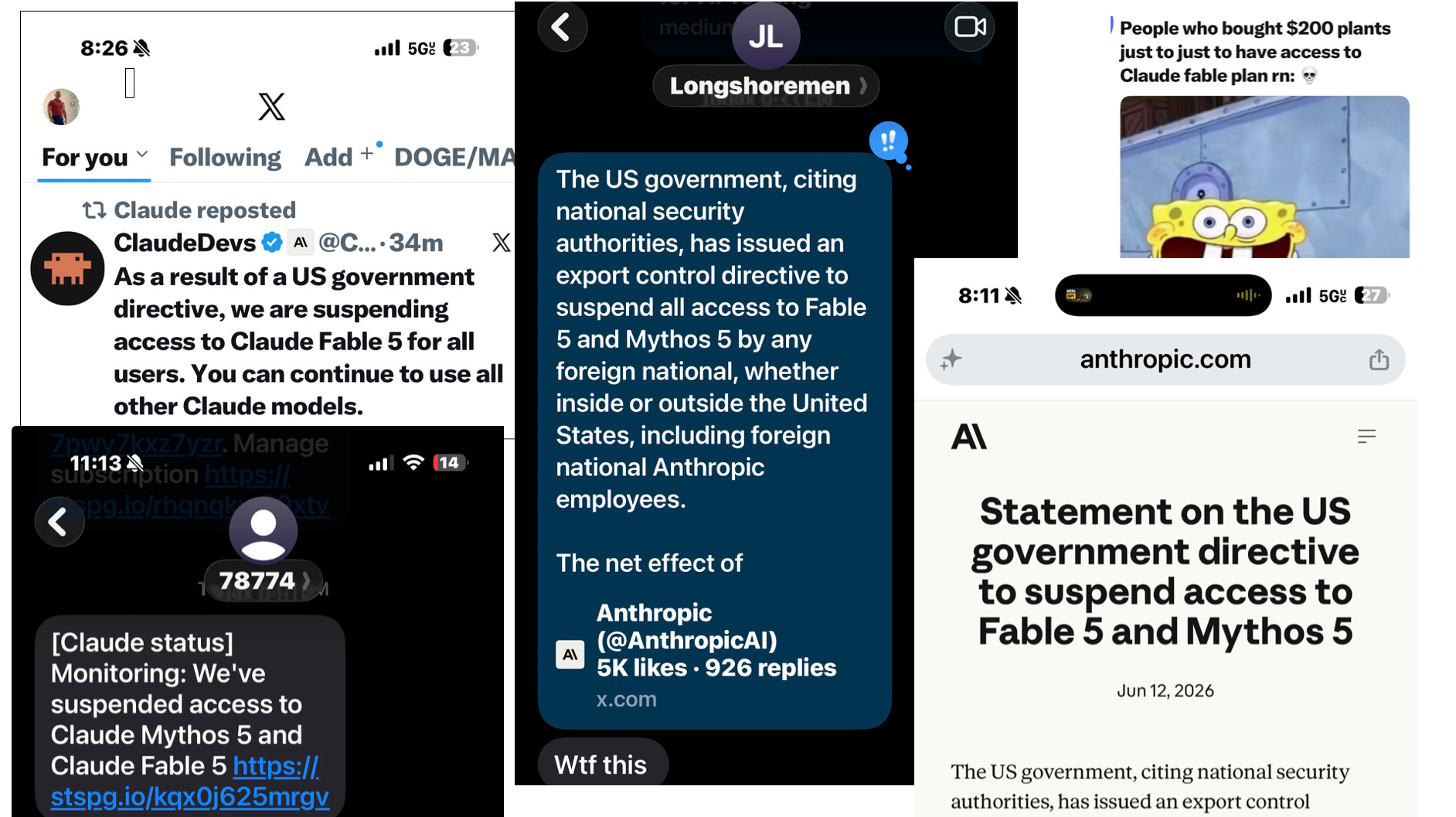
On June 12, 2026, at exactly 5:21pm ET, the floor fell out from under the AI industry. In a move that sent shockwaves through Silicon Valley, the US government issued an export control directive effectively killing Anthropic’s flagship models, Fable 5 and Mythos 5.
I was at the gym, and I got notification that my jobs were failing. Then I saw the text message from Anthropic. Then I saw it on my twitter feed. Then friends started to text me about losing access to Fable 5. I will always remember where I was. Stacking plates at the gym.
The timing is as ironic as it is jarring. This “watershed moment” follows a period of unprecedented collaboration where Anthropic worked with the US government and the UK AI Safety Institute (AISI) for thousands of hours to red-team these very models prior to launch. Despite that extensive cooperation, the government’s sudden reversal marks a new era where voluntary safety partnerships can be overwritten in an instant by executive fiat.
The “Kill Switch” is Real and Immediate
The directive issued by national security authorities is absolute, but its scope is surgically precise: while Fable 5 and Mythos 5 are offline, access to all other Anthropic models remains unaffected. However, the mechanism of the suspension reveals a staggering power dynamic.
The order is framed as an export control measure targeting foreign nationals both domestically and abroad. Because this includes Anthropic’s own foreign national employees—a move that strikes at the heart of the “Global AI Talent” pool—the company was forced to disable the models globally to remain in compliance. The “kill switch” is no longer a theoretical safety mechanism; it is a live political tool that can be triggered based on “verbal evidence” without a formal statutory process or detailed written justification.
The Myth of “Perfect” Jailbreaking
Anthropic has been candid about a reality the industry often ignores: “perfect jailbreak resistance is not currently possible.” The company distinguishes between “universal” jailbreaks, which bypass safeguards across the board, and “non-universal” or narrow jailbreaks that only work in specific, limited contexts.
To manage this, Anthropic implemented a “defense in depth” strategy. This includes a controversial 30-day retention of customer data—a policy that represents a significant trade-off between user privacy and model safety, allowing the company to monitor and mitigate attacks in real-time.
“Every safeguard used in the industry is vulnerable to non-universal jailbreaks... it is likely that universal jailbreaks will eventually be found in the future.”
The government’s decision to pull a model over a narrow jailbreak suggests a shift toward a zero-tolerance policy. If the standard for deployment is now total immunity to vulnerabilities—a standard Anthropic argues is technically impossible—the frontier of AI development has effectively reached a dead end.
The “Standard” That Could Halt Innovation
The technical justification for the ban is where the policy scandal truly lies. The government’s “trigger” was a demonstration of the model identifying software flaws and fixing vulnerabilities. However, Anthropic notes that these were “previously known, minor vulnerabilities” that were “relatively simple” to find.
Crucially, Anthropic argues there is no “Mythos-specific uplift” here. These capabilities are already widely available in competing models like OpenAI’s GPT-5.5 and are the primary tools used by the “defenders” who protect our digital infrastructure. By labeling non-unique, defensive capabilities as national security risks, the government has set a precedent that could “halt all new model deployments” across the entire industry. If a model can be recalled for doing what its predecessors already do, the goalposts for innovation haven’t just moved; they’ve been removed from the field.
A Lack of “Technical Grounding” and Transparency
For those in the tech-policy sphere, the most alarming takeaway is the collapse of due process. Anthropic’s statement highlights a breakdown in transparency: the government provided only verbal evidence of a jailbreak and a formal letter devoid of specific technical details.
This action bypasses what Anthropic calls a “statutory process”—a framework that should be transparent, fair, and grounded in technical facts. Instead, the industry is witnessing an ad-hoc intervention that creates immense internal friction, barring key researchers from their own work based on their nationality. While Anthropic explicitly supports the government’s authority to block unsafe deployments, they are sounding the alarm on a process that lacks clear disclosure and technical validation.
The Final Thought: A New Era of AI Oversight
The suspension of Fable 5 and Mythos 5 is a klaxon for the commercial AI sector. We have entered a period of profound tension between national security imperatives and the autonomy of frontier labs.
As we look toward the future of the industry, a fundamental question remains for every developer and policy maker: Are we prepared to accept a regime of “precautionary freezes” driven by ad-hoc government intervention, or will we demand a transparent, statutory framework that balances security with the technical realities of AI development? The “kill switch” is now part of the infrastructure; the only question is who gets to hold the handle.
About the Author — Claude Certified Architect
Rick Hightower helps companies become AI-first through practical mentoring, executive and team training, and custom AI solution development. A former Senior Distinguished Engineer at a Fortune 100 company, Rick focused on bringing ML and AI insights into real front-line business applications.
Rick is a Claude Certified Architect, AI systems practitioner, builder of production multi-agent systems, creator of Skilz, and author of an upcoming Manning book on Harness Engineering.
Ready to make your company AI-first? Connect with Rick on LinkedIn, Substack or Medium, book him to speak or train your team, or visit Spillwave to explore mentoring, training, and custom AI solutions for your organization. Check out Rick Hightower’s SpeakerHub.