
What Is Harness Engineering? Harness Engineering Explained for the Impatient
The runtime around the model matters more than the model. Here is the discipline in about 1,400 words, plus eight articles that prove it one production failure at a time.

AI Harness Engineering: a history lesson of ancient AI history from 2024, 2025, and last month
I wrote the long version of this story a few weeks ago: What Is Harness Engineering? The Engineering Discipline for Production AI Agents. It traces the full lineage, from a 1947 cockpit study through the SWE-agent paper to the 2026 naming convergence. This is the short version, sharpened by the research I have been doing for the Harness Engineering book I am writing for Manning, and it doubles as the front door to the Harness Engineering series: eight articles that take the definition below and stress-test it against production failures, two frameworks at a time.
Please subscribe, like, comment, or share; it really helps grow the channel and supports the work.
The model is the easy part
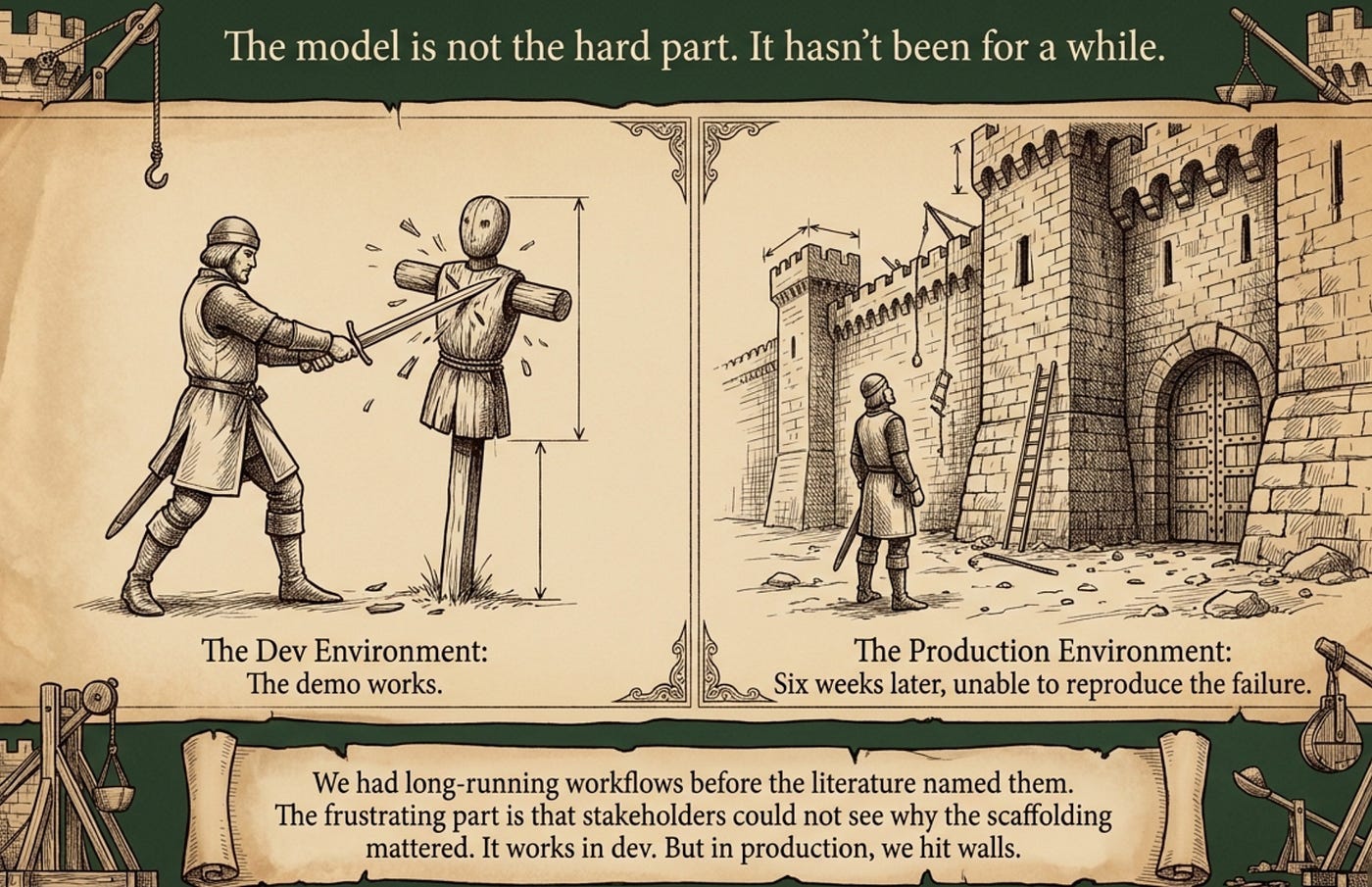
Harness Engineering: The model is not the hard part
The model has not been the hard part for a while. At Spillwave, and at the client teams I consulted for, we were building harnesses before the term existed. Long-running agentic workflows that resumed cleanly after interruption. Programmatic validation of generated queries. LLM-as-judge loops. Drift detection on every model, prompt, or tool-contract change. None of it had names. We pulled it out of necessity.
If you are a paid subscriber, thank you. Your support makes this work possible.
If you are a free subscriber and find these articles useful, please consider upgrading. A paid subscription is $80 per year or $8 per month.
