
Understanding why AI Agentic System Fail In Production
Four key definitions needed for production grade Agents and Agentic Workflows.

There are four critical definitions that are important for understanding why AI agents fail in production. It is important not to confuse these concepts. Confusing these concepts could mean you are applying the wrong controls to fix a problem. A demo agentic system might come off amazing, and it passes every smell test. But when you actually deploy this agentic system to production, the wheels start to fall off when you start facing real-world traffic.
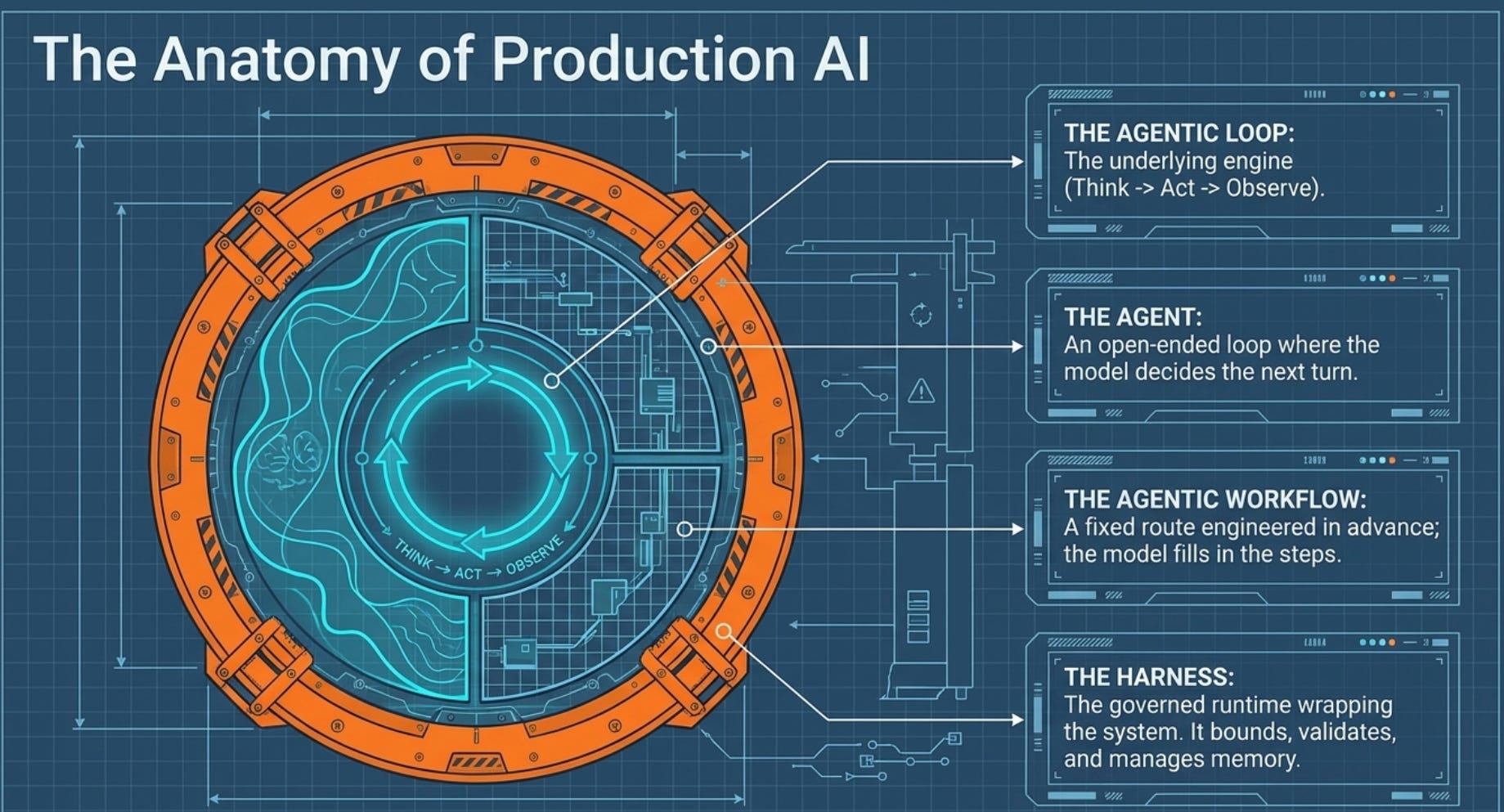
The four foundational components for production agents are:
The Agentic Loop: This is the engine that allows the model to decide the next action, and the runtime that executes it. The result of the action is observed, and then the loop decides what the next action is. This goes on until a goal or a stop condition is met.
The Agentic Workflow: A fixed route engineered in advance. Instead of the model deciding the sequence of actions, the developer dictates the contract (e.g., classify, retrieve, validate, respond) and the model merely executes within those boundaries. This approach provides determinism and debuggability, though it trades off some flexibility and can be brittle if reality steps outside the pre-drawn route.
The Agent: The agent is the system that runs an open-ended agentic loop. The model is trusted to decide what to do each turn of this loop. An agent is a super flexible agentic system. It has a lot of power. With power comes great responsibility, and sadly risk. An agent that runs without guardrails can make a fairly serious mistake. Models are non-deterministic, and without constraints, their tendency to hallucinate can lead to breaking policies, double-charging a customer, or worse. This sort of thing is not just hypothetical; there are real cases, e.g., an Air Canada AI system double-charged a customer's credit card while making up a seat confirmation that did not exist.
The Harness: This provides the guardrails that you use to manage an agent or agentic workflow and keep it on track. The harness is an essential layer to avoiding costly and reputational-damaging errors. The harness is a critical layer to provide governance.
How this context explains production failures: A common pitfall in AI development is attempting to fix unpredictable agent behavior by upgrading the underlying model or endlessly tweaking prompts. However, the sources emphasize that the model usually isn’t what breaks; the controls around it do.
