
The Harness: The New Operating System for Agentic AI Scaling
Something shifted in early 2025, and if you build agentic AI systems professionally, you probably felt it before you named it.

Your agents keep failing in production even as the models get dramatically smarter, and the reason is not the model. The leverage point has shifted to the harness, and the teams that treat it as infrastructure rather than an afterthought are already pulling ahead by double-digit percentages without changing a single weight.
In this article: In early 2025, something fundamental shifted: foundation models kept improving, yet the teams shipping the most capable production agents were no longer just swapping models—they were engineering the harness, the deliberate runtime layer of prompts, tools, memory, and control flow that sits around the model. Drawing on the 502-paper RUCAIBox survey, the HarnessX foundry (+14.5 % average benchmark gains, up to +44 % with the same weights), and the CAAF controllability framework, this article gives harness engineering its first rigorous map: four pillars, three evolutionary layers, and a practical maturity lifecycle that moves from explore-and-evolve (HarnessX) to constrain-and-verify (CAAF). The model is the CPU; the harness is the OS you own. That is where the real performance headroom and production reliability now live.
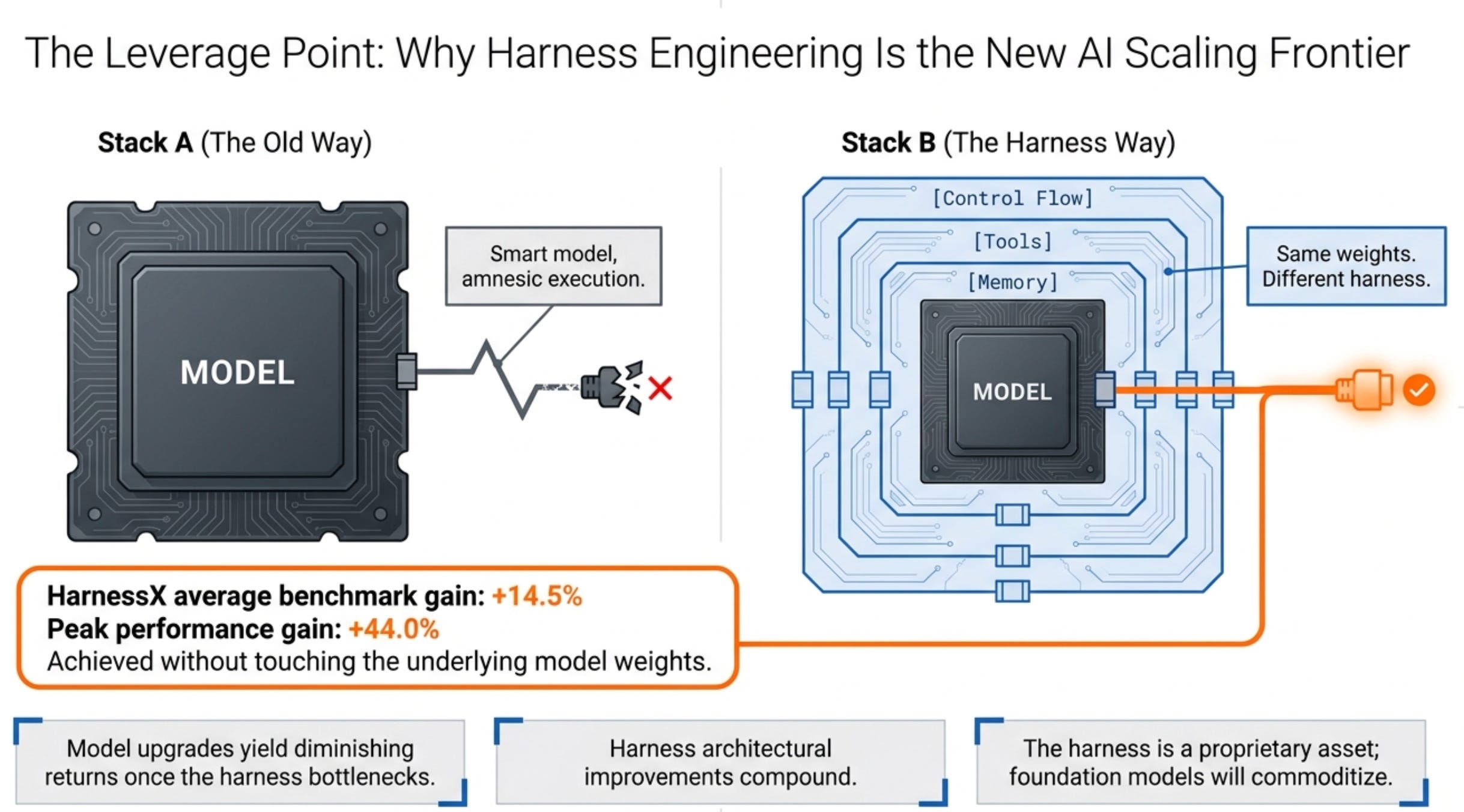
The Leverage Point: Why Harness Engineering Is the New AI Scaling Frontier
Something shifted in early 2025, and if you build agentic AI systems professionally, you probably felt it before you named it.
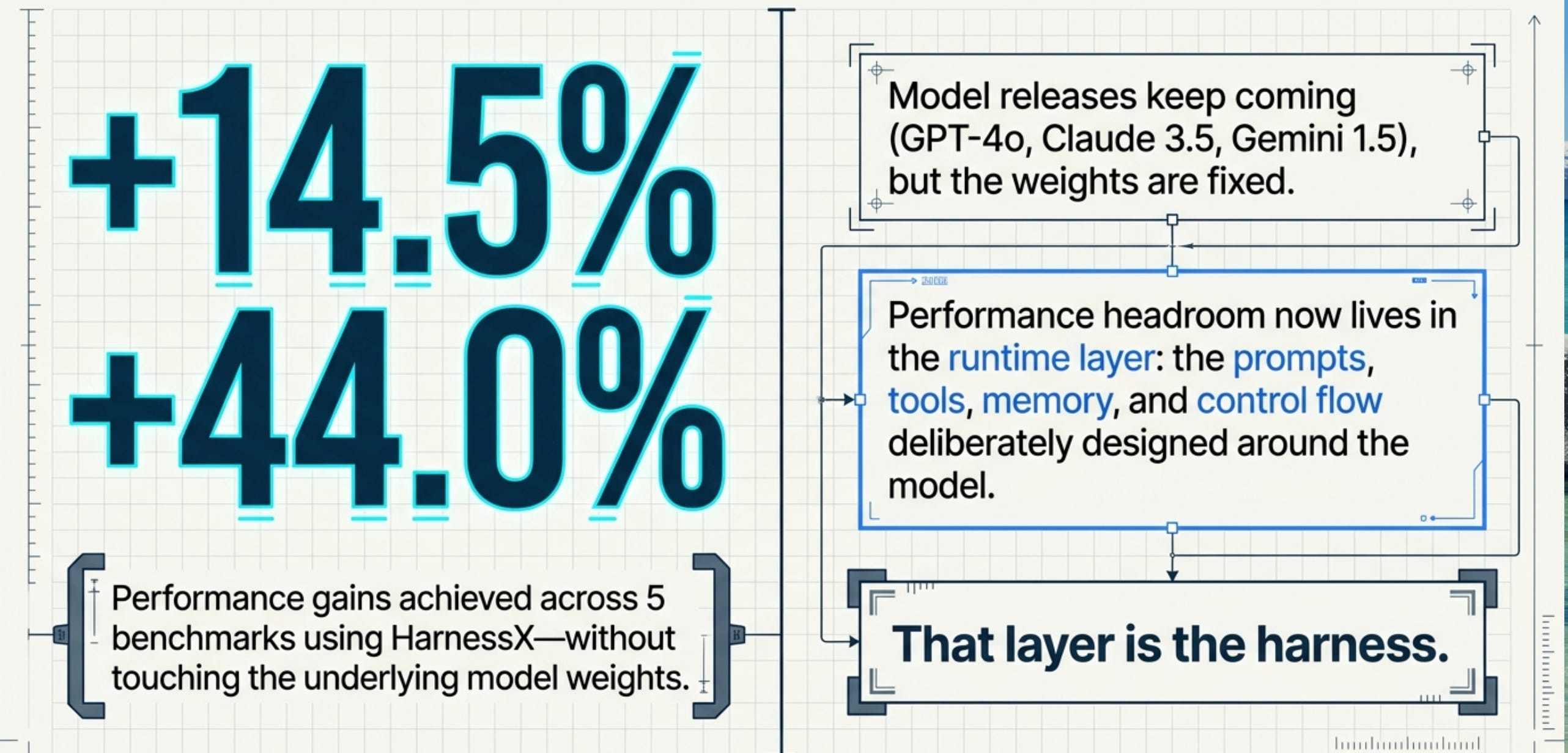
Model releases kept coming. GPT-4o, Claude 3.5 Sonnet, Gemini 1.5 Pro. Each one measurably smarter than the last on benchmarks. But the teams shipping the most capable production systems were not just swapping in newer models. They were investing in harness engineering: the prompts, tools, memory, and control flow deliberately designed as the layer around the model, mediating how it observes the world, reasons about it, and acts in it. That layer now has a name: the harness.
The shift is quantifiable. HarnessX reports an average +14.5% gain across five benchmarks, and up to +44.0%, without changing the underlying model; same weights, different harness. As the authors frame it, the performance headroom lives in the runtime layer, not the model weights. That number changes the conversation about where engineering effort belongs. [1]
Three interconnected developments give the harness engineering field what it previously lacked: a vocabulary, a performance proof, and a control-theory grounding.
The RUCAIBox survey: “Agent Systems with Harness Engineering,” a synthesis of 502 references with an actively maintained companion repository (RUCAIBox/awesome-agent-harness, MIT license, last updated 2026-05-19). [RUCAIBox, awesome-agent-harness, GitHub, MIT License, last updated 2026-05-19; https://github.com/RUCAIBox/awesome-agent-harness] Renmin University of China AI Box (RUCAIBox) is the research group behind it. The survey provides the field with its first structured taxonomy: four pillars, three evolutionary layers, and a reading map of the literature.
HarnessX (arXiv:2606.14249): a harness foundry built around composability, adaptability, and evolvability. It operationalizes the claim that harness architecture is a primary performance lever. [1]
CAAF (arXiv:2604.17025): the Convergent AI Agent Framework, which reframes the harness as a deterministic enterprise asset for safety-critical and regulated sectors. [2]
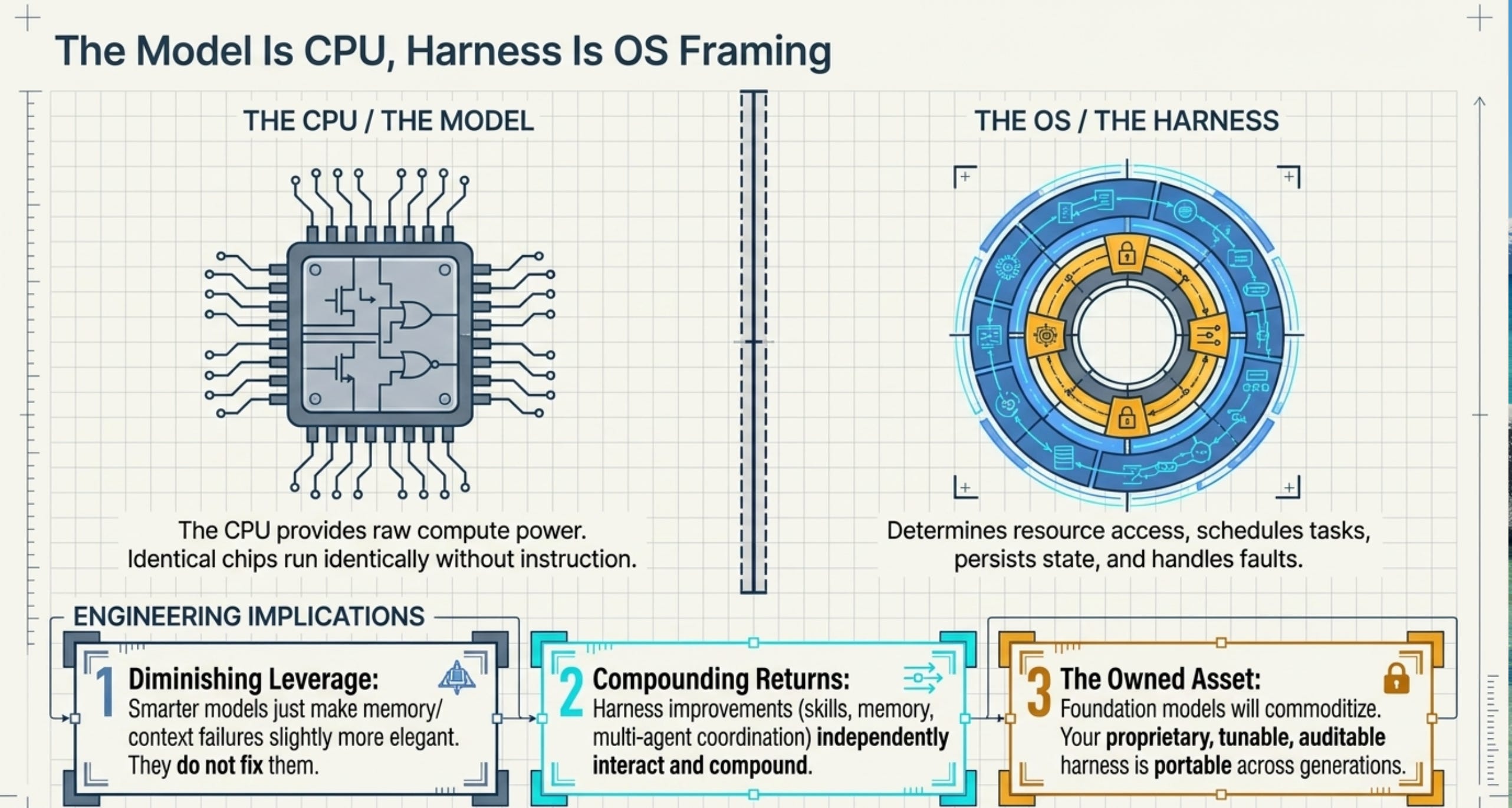
The “Model Is CPU, Harness Is OS” Framing
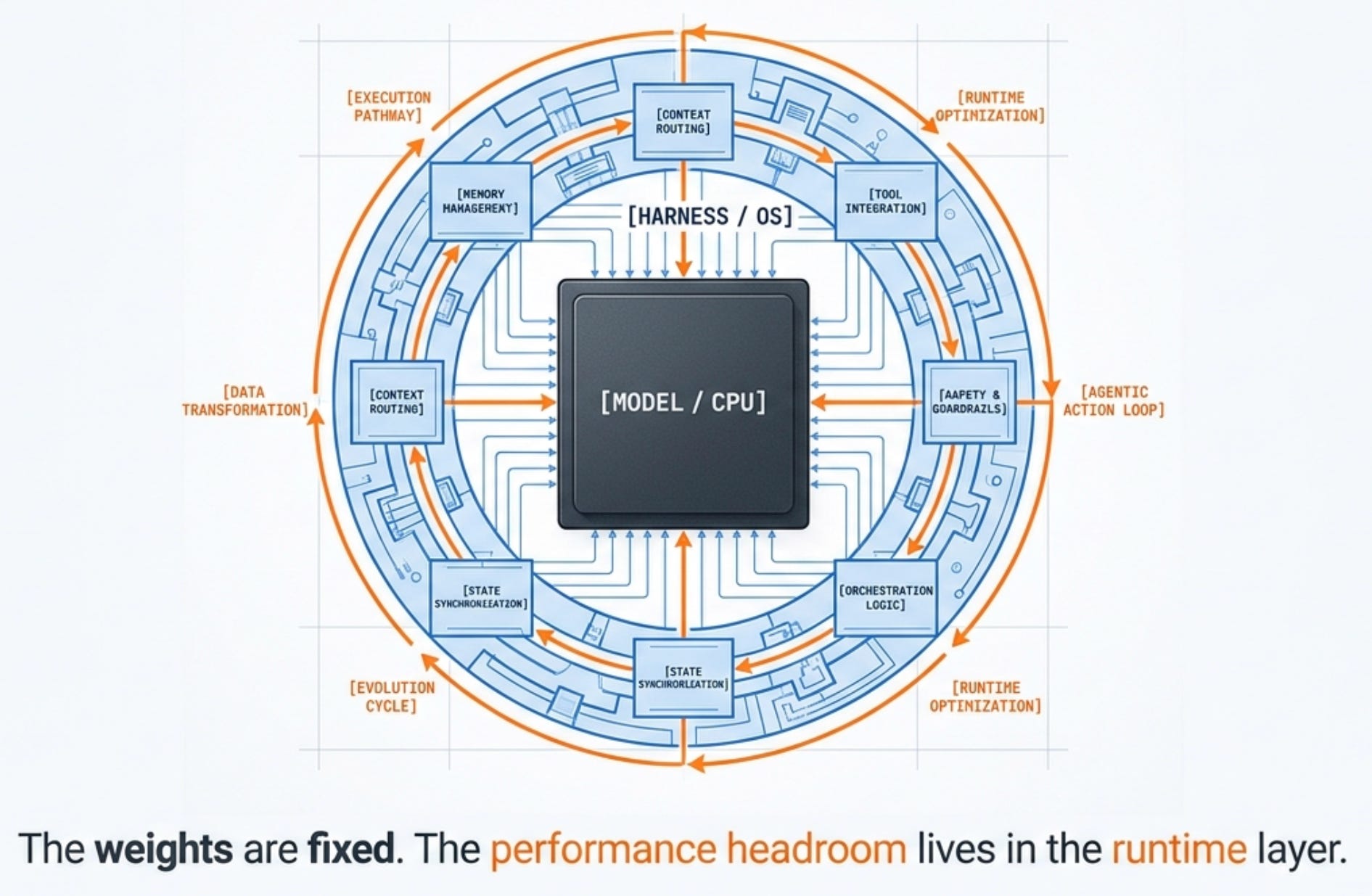
The analogy that keeps proving useful is this: the model is the CPU, and the harness is the operating system.
If you are a paid subscriber, thank you. Your support makes this work possible.
If you are a free subscriber and find these articles useful, please consider upgrading. A paid subscription is $80 per year or $8 per month.
Free subscribers typically receive access to the full versions of paid articles after one to two months.
