
The Agentic AI Certification Landscape: Why This Moment Matters
A practical map of the AI agent certification stack, from NVIDIA’s GPU infrastructure layer to AWS, Azure, Google, Anthropic, and LangChain, and how to choose the credential path that actually matches

The AI certification gold rush is here, and it is already getting confusing enough to waste your money, your study time, and your career signal. The real winners will not collect random badges; they will understand which layer of the agentic AI stack they are proving they can actually build.
The Agentic AI Certification Landscape: Why This Moment Matters
Every major AI platform launched or overhauled its own agentic AI certification in 2025 and 2026. NVIDIA introduced the Agentic AI Professional (NCP-AAI). Anthropic launched the Claude Certified Architect - Foundations (CCA-F). AWS expanded its portfolio with the Certified Generative AI Developer - Professional (AIP-C01). Google updated its Professional Machine Learning Engineer cert for the agentic era. Azure retired AI-900 and AI-102 on June 30, 2026, replacing them with AI-901 and AI-103. LangChain built an academy around completion-based certificates. Each one claims to be the credential practitioners need. They cannot all be right, at least not for the same practitioner.
Here is what is actually happening. The agentic AI certification landscape is fragmenting along the same fault lines as cloud infrastructure did in the 2010s. When AWS, Azure, and Google each built rival certification programs, engineers who understood all three platforms became more valuable than those who mastered only one. Something similar is happening now with AI Agents. The difference is that the fragmentation is not just across vendors. It is across layers of the stack.
Three distinct layers have emerged. At the infrastructure layer, NVIDIA’s NCP-AAI covers GPU-accelerated inference, model serving with NIM (NVIDIA Inference Microservices), and the compute fundamentals that make large-scale AI Agents practical in production. At the cloud integration layer, AWS, Azure, and Google Cloud certifications address managed AI services, MLOps pipelines, and cloud-native deployment patterns. At the application and orchestration layer, programs like Anthropic’s CCA-F and LangChain Academy focus on LLM APIs, multi-agent system design, RAG pipelines, and prompt engineering.
No single certification covers the full agentic AI stack from infrastructure to orchestration. That is not a gap to complain about. It is a strategic opportunity. Practitioners who understand how these layers connect, and who stack certifications deliberately, become the engineers who bridge the gap between what AI platforms offer and what production systems actually require.
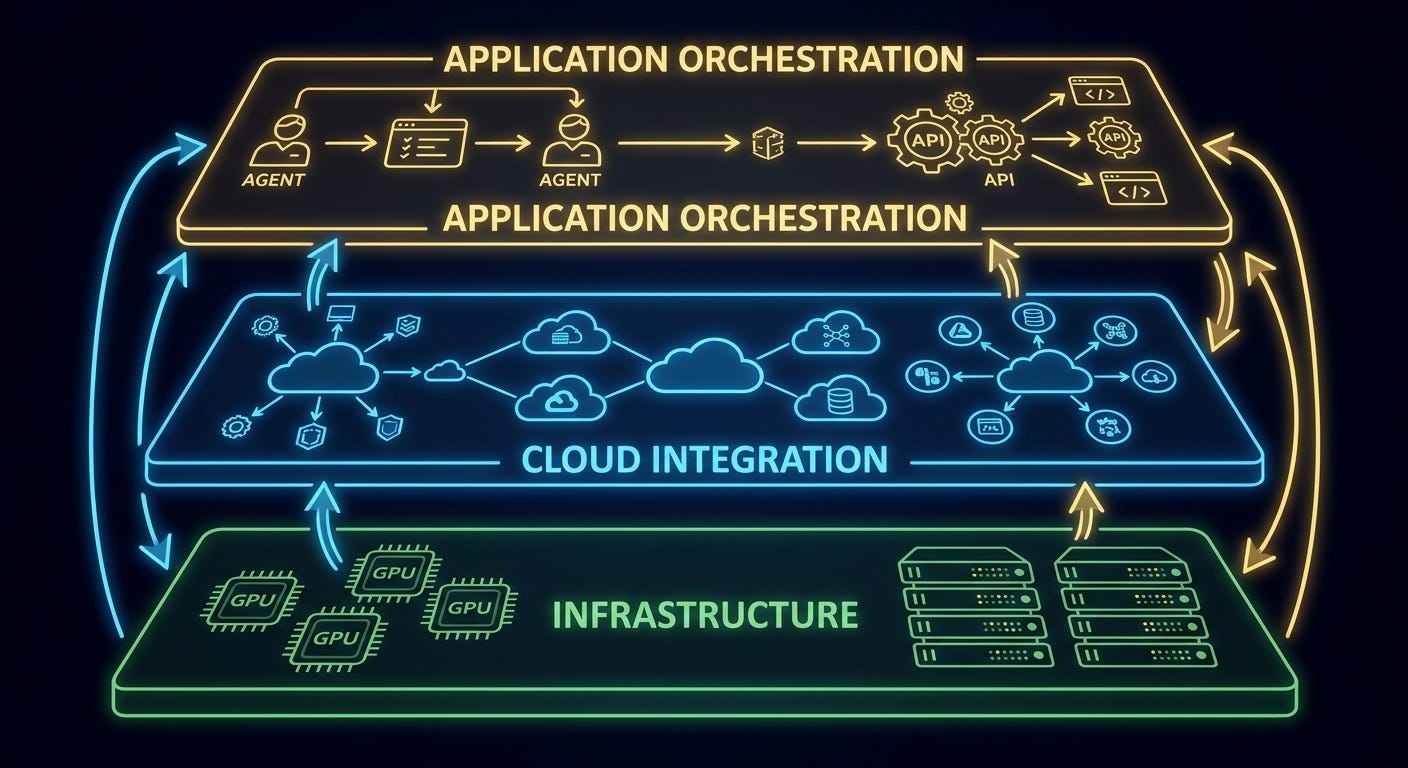
This article is the strategic map.
If you are a paid subscriber, thank you. Your support makes this work possible.
If you are a free subscriber and find these articles useful, please consider upgrading. A paid subscription is $80 per year or $8 per month.
Free subscribers typically receive access to the full versions of paid articles after one to two months.
The Agentic AI Certifications Covered in This Article
The certifications surveyed here span every layer of the stack:
NVIDIA-Certified Professional: Agentic AI (NCP-AAI) sits at the infrastructure layer, published by NVIDIA.
Claude Certified Architect - Foundations (CCA-F) operates at the application layer, published by Anthropic.
AWS Certified AI Practitioner (AIF-C01) targets cloud integration, published by AWS.
AWS Certified Generative AI Developer - Professional (AIP-C01) targets cloud integration and application depth, published by AWS.
Microsoft Azure AI-901 (Azure AI Fundamentals) and AI-103 (Azure AI App and Agent Developer Associate) cover cloud integration; AI-900 and AI-102 both retired June 30, 2026.
Google Cloud Professional Machine Learning Engineer covers cloud integration and MLOps, published by Google.
LangChain Academy completion certificates (not a proctored vendor exam) sit at the orchestration layer, published by LangChain.
With the confirmed certifications, retirement timelines, and platform distinctions established, the focus turns to the NVIDIA Agentic AI Professional certification. Of all the credentials surveyed, this one sits closest to the infrastructure layer, concerned not with which LLM to call, but with how to deploy, evaluate, and govern AI Agents at the GPU level. Understanding its structure, domains, and available preparation resources gives practitioners a clear picture of what differentiates NVIDIA’s credential from the LLM-platform certs that surround it.
What the NCP-AAI Actually Tests
Not which LLM to call. How to deploy them efficiently at scale.
The exam covers multi-agent design, RAG, evaluation, deployment, monitoring, safety, and NVIDIA platform implementation. Official resources available to candidates include the exam page, the study guide and blueprint, DLI courseware, and the cert-prep webinar series. The prep ecosystem is less mature than the Azure AI certification track, which matters for how you study. Third-party practice providers exist, but they are not the anchor. Official NVIDIA resources are.
NCP-AAI Exam Format and Structure
The NVIDIA Agentic AI Professional certification carries exam code NCP-AAI (full name: NVIDIA-Certified Professional: Agentic AI). The exam is delivered online with remote proctoring through Certiverse.
The exam details break down as follows:
Exam code: NCP-AAI
Format: Online, remotely proctored via Certiverse
Duration: 120 minutes
Questions: 60 to 70
Price: $200 USD
Certification validity: 2 years from issuance
Source: NVIDIA Agentic AI LLMs Certification page, retrieved June 2026.
NVIDIA Agentic AI Professional Exam Domains
The official NVIDIA study guide organizes the exam into five blueprint domains.
The five domains and their key topics:
Agent Design and Cognition: Architecture, reasoning, planning, memory, multi-agent coordination
Knowledge Integration and Agent Development: Retrieval pipelines, data handling, prompt engineering, reliability
NVIDIA Platform Implementation and Deployment: Inference optimization using NIM, GPU-accelerated inference, production workflows
Evaluation, Monitoring, and Maintenance: Benchmarking, live monitoring, observability, troubleshooting
Human, Ethical, and Compliance Considerations: Human-in-the-loop design, safety guardrails, responsible AI
Source: NVIDIA Agentic AI LLMs Certification page, retrieved June 2026.
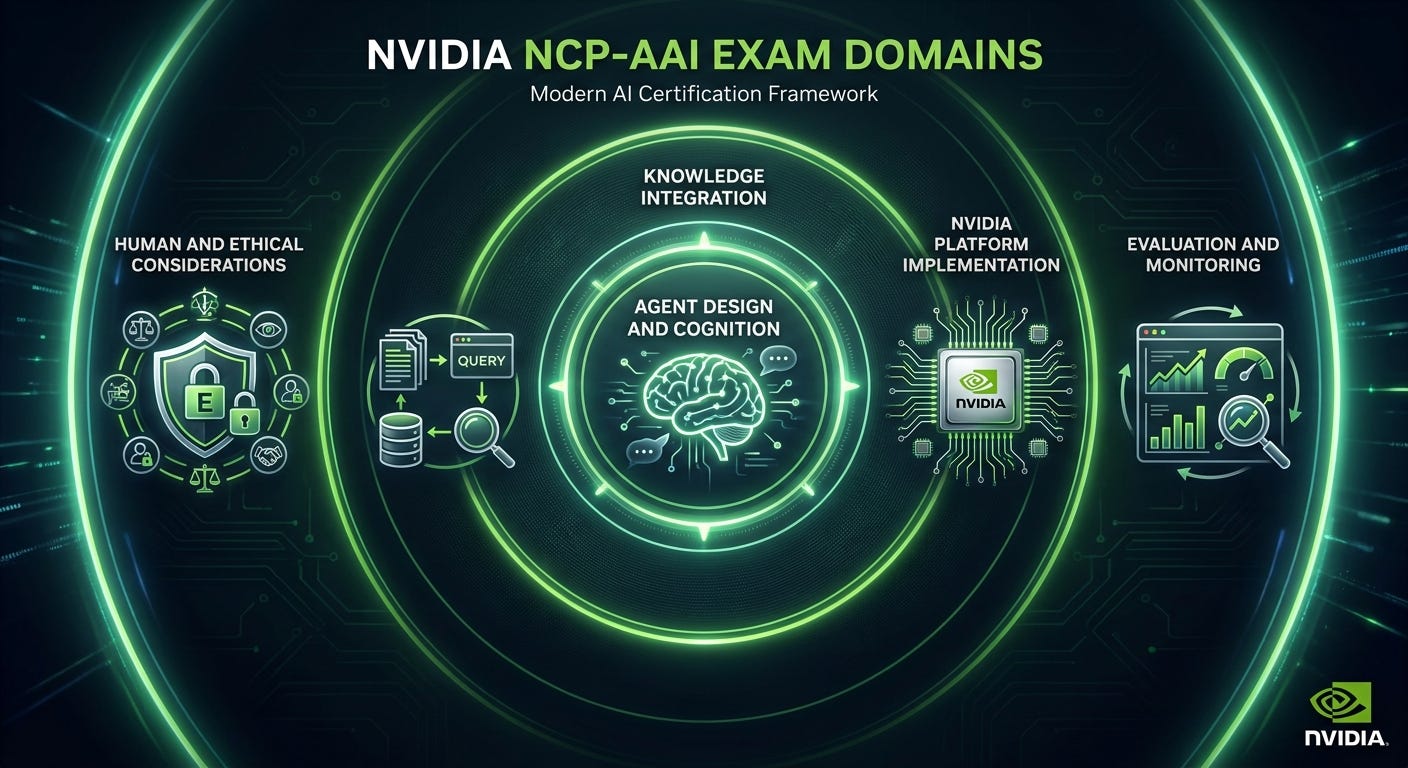
In practice, the full domain weights are not prominently displayed on the main certification landing page and are more easily found in the downloadable Study Guide PDF linked from that page. The Study Guide PDF is available via the official NVIDIA certification page and linked registration portal; creating a Certiverse account (required for exam registration) provides access to the full study materials. Get the study guide first.
NIM (NVIDIA Inference Microservices) appears explicitly in Domain 3. NIM are prepackaged, GPU-optimized inference containers that expose an OpenAI-compatible API and deploy on any NVIDIA-accelerated infrastructure. Think of them as Docker images purpose-built for running models on NVIDIA GPUs, with a drop-in OpenAI-compatible endpoint.
How to Prepare: Priority Order
1st priority:  NVIDIA Exam Study Guide (official blueprint: exam domains + weights)
2nd priority:  NVIDIA DLI courseware (official, certification-aligned training)
3rd priority:  NVIDIA cert-prep webinars (exam structure, sample Qs, Q&A)
4th priority:  Third-party practice tests (gap-finding ONLY, not source of truth)
               Whizlabs, Preporato, FlashGenius
Start with the official study guide. Turn each of the five domains into a checklist. Use DLI courses for weak areas. Run third-party practice tests only to find gaps, not to learn from. The prep ecosystem for this cert is still maturing, and some third-party question banks may lag the current domain structure.
NVIDIA Cert-Prep Webinar Series
NVIDIA has run “How to Prepare for NVIDIA Generative AI Certification” webinars covering exam structure, topic focus, prep strategies, sample questions, and live Q&A. The event page specifically calls out the Professional: Agentic AI exam. Attend these webinars, or watch them on demand, early in your prep cycle. They give a ground-level view of what NVIDIA considers exam-critical.
NVIDIA DLI Courses for NCP-AAI Prep
The following courses appear on the official NCP-AAI certification page as associated training from NVIDIA DLI (Deep Learning Institute), NVIDIA’s official training arm.
The DLI course lineup, with format, duration, and price:
Building RAG Agents With LLMs: self-paced, 8 hours, $90
Building Agentic AI Applications With LLMs: self-paced, 8 hours, $90
Introduction to Deploying RAG Pipelines for Production at Scale: self-paced, 8 hours, $90
Evaluating RAG and Semantic Search Systems: self-paced, 3 hours, $30
Adding New Knowledge to LLMs: instructor-led, 8 hours, $500
Source: NVIDIA Agentic AI LLMs Certification page, retrieved June 2026. Prices subject to change; verify on learn.nvidia.com before purchasing.
The self-paced courses align directly with the exam’s five domains. “Building Agentic AI Applications With LLMs” maps most closely to Domain 1 (Agent Design and Cognition) and Domain 2 (Knowledge Integration). “Building RAG Agents With LLMs” and “Introduction to Deploying RAG Pipelines for Production at Scale” cover Domain 2 and Domain 3 respectively. “Evaluating RAG and Semantic Search Systems” targets Domain 4 (Evaluation, Monitoring, and Maintenance). The instructor-led “Adding New Knowledge to LLMs” is the highest-cost option and best suited for teams that prefer instructor-led learning over self-paced study.
Prep Ecosystem Maturity: NVIDIA vs. Azure vs. AWS
The NVIDIA Agentic AI Professional cert is newer and has a thinner prep ecosystem than either the Azure AI certification track or the AWS AI certification portfolio. That gap matters for how you plan your study.
Azure side: AI-102 (Azure AI Engineer Associate) retired June 30, 2026 and is succeeded by AI-103 (Azure AI Apps and Agents Developer Associate), which entered beta in April 2026 and went live around June 2026. AI-103 is itself a new exam with third-party prep materials still building out. What the Azure track brings, however, is a deep bench of study guides, instructor networks, and practice resources built up across years of AI-102 exam prep. That foundation gives AI-103 candidates a meaningful head start. If you covered AI-102 material, you will find significant overlap with AI-103’s focus on Azure AI Foundry, multi-agent orchestration, and generative AI development.
AWS side: The AWS Certified Machine Learning Specialty retired March 31, 2026. Its successors, the AWS Certified Generative AI Developer - Professional and the AWS Certified Machine Learning Engineer - Associate, inherit an AWS certification ecosystem (Udemy courses, A Cloud Guru, official AWS training) that is denser than what currently exists for NCP-AAI.
Implication for NVIDIA candidates: Rely heavily on official NVIDIA resources. Third-party question banks for NCP-AAI are thin and may not reflect current exam domains. The DLI courses are the best hedge against a sparse prep ecosystem because they are certification-aligned and authored by NVIDIA itself.
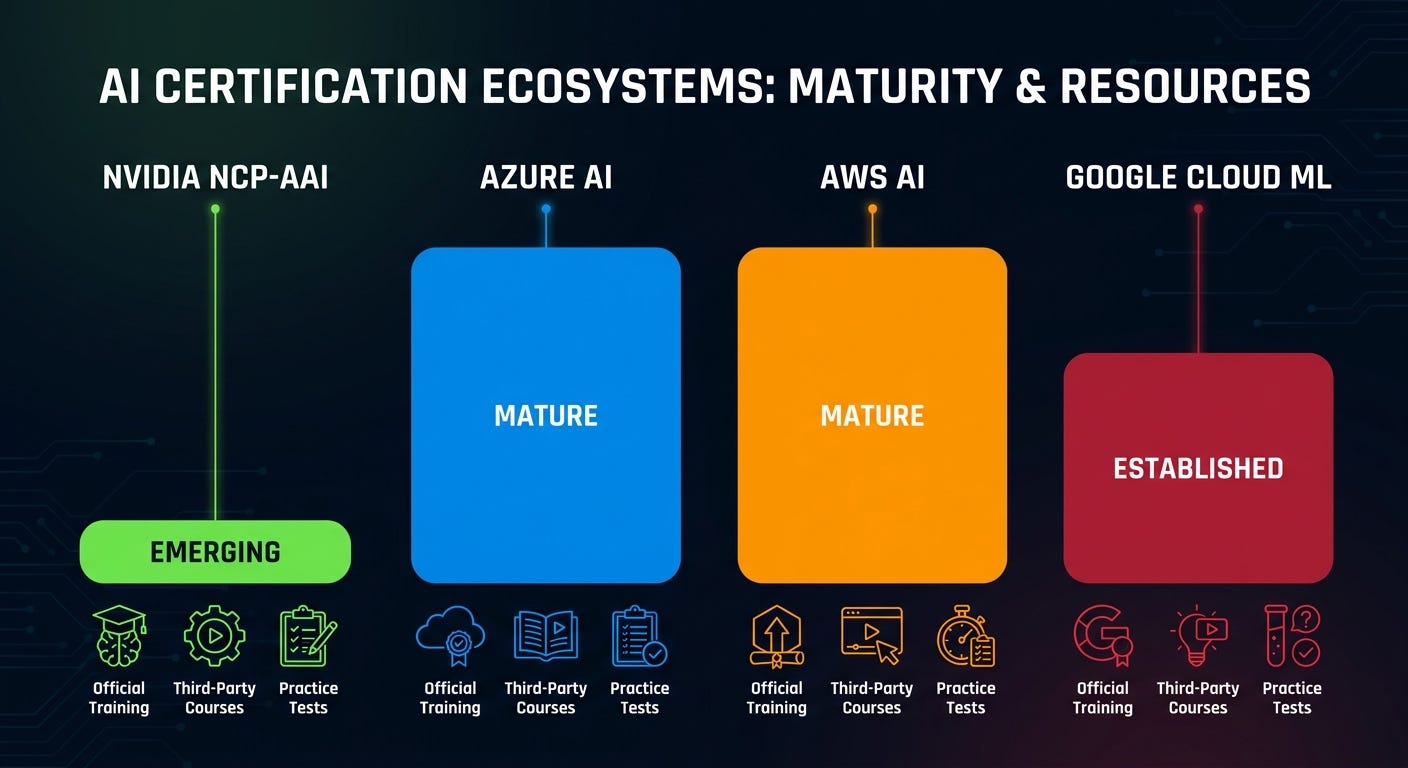
With the NVIDIA NCP-AAI examined in depth, the natural next question is how it fits within the broader field. No certification exists in isolation, and practitioners rarely choose just one. The next section maps the full agentic AI certification landscape across AWS, Azure, Google Cloud, Anthropic, and LangChain to show where each credential sits in the stack and who it actually serves.
What Each Credential Actually Covers
Agentic AI certifications now span every layer of the stack, and NVIDIA’s NCP-AAI is only one credential in a rapidly expanding field. This section surveys the competition: the Anthropic CCA-F as the clearest architect-level counterpart; the AWS Certified AI Practitioner (AIF-C01) and AWS Certified Generative AI Developer - Professional (AIP-C01), successor to the retired AWS ML Specialty; Microsoft Azure AI certifications in active transition (AI-900 and AI-102 both retired June 30, 2026, replaced by AI-901 and AI-103); the Google Cloud Professional Machine Learning Engineer, updated in 2026 for Vertex AI Agent Builder and Gemini integration; and LangChain Academy. Hugging Face, Cohere, and Databricks round out the honorable mentions.
For each cert, what follows characterizes the layer it occupies, the audience it targets, and its hands-on versus theory emphasis.
AI Certification Profiles by Layer and Audience
Anthropic CCA-F: Application-Layer Agentic AI Certification
Layer: Application and orchestration. Audience: Engineers and architects building production systems on the Anthropic platform, primarily targeted at employees of official Anthropic partner companies, though individuals without a qualifying organization can request access through the Anthropic Skilljar portal. Broader public access is widely expected later in 2026.
Exam format: Proctored exam at the Foundations level; 60 multiple-choice questions, 120-minute time limit, passing score 720/1000. Exam fee: $99 USD; the first 5,000 Claude Partner Network employees receive it free.
Platform focus: Claude (Anthropic), prompt engineering, safety and constitutional AI, multi-agent patterns. Top domain is Agentic Architecture and Orchestration (27% of exam). Hands-on ratio is mixed: architecture patterns combined with practical Claude API usage.
Prep resource: Anthropic Academy (anthropic.skilljar.com): 13 free self-paced courses launched in March 2026.
Employer recognition: Emerging; Anthropic brand is strong in AI-native companies. Launched March 2026 as the first vendor-backed certification for building with Claude AI Agents.
AWS Certified AI Practitioner (AIF-C01): Foundational Cloud AI Certification
Layer: Cloud integration. Audience: Broad: practitioners, managers, and non-engineers wanting foundational AI fluency.
Exam format: Proctored; 65 questions (50 scored, 15 unscored), 90-minute time limit, passing score 700/1000, exam fee $100 USD.
Platform focus: AWS AI/ML services (SageMaker, Bedrock, Comprehend, Rekognition, and others). Domains include Fundamentals of GenAI (24% of scored content), Applications of Foundation Models (28% of scored content), and Guidelines for Responsible AI (14% of scored content). Primarily theory and conceptual.
Employer recognition: High (AWS brand).
AWS Certified Generative AI Developer - Professional (AIP-C01): Deep Cloud AI Certification
Layer: Cloud integration and application. Audience: Developers with 2+ years building production-grade applications on AWS.
Exam format: Proctored; beta ended March 31, 2026, standard exam now available; passing score 750/1000, exam fee $300 USD.
Platform focus: Amazon Bedrock, AWS GenAI stack; multi-modal, RAG, AI Agents. More technical than the AI Practitioner; heavy scenario and application emphasis.
Employer recognition: High (AWS brand). Successor credibility to the retired ML Specialty. The AWS Certified Machine Learning Specialty retired March 31, 2026; AIP-C01 and the AWS Certified Machine Learning Engineer - Associate (MLA-C01) are its successor paths.
Microsoft Azure AI-901 (Azure AI Fundamentals)
Layer: Cloud integration. Audience: Beginners, career-switchers, and non-engineers needing an AI literacy credential.
Exam format: Proctored. Primarily conceptual.
Platform focus: Azure AI services broadly. AI-901 shifts emphasis toward building AI applications and agents using Microsoft AI Foundry. Employer recognition: High (Microsoft brand; widely recognized entry-level).
Transition alert: AI-900 retired June 30, 2026, replaced by AI-901 (beta launched April 21, 2026). Existing AI-900 holders do not need to retake. New candidates take AI-901 going forward. Both exams lead to the same Microsoft Certified: Azure AI Fundamentals credential.
Microsoft Azure AI-103 (Azure AI App and Agent Developer Associate)
Layer: Cloud integration and application. Audience: Engineers building AI solutions on Azure.
Exam format: Proctored; rich third-party prep ecosystem.
Platform focus: Azure Cognitive Services, OpenAI on Azure, Bot Framework, Azure ML. Significant hands-on labs.
Employer recognition: High (mature, established cert).
Transition alert: AI-102 and the Azure AI Engineer Associate certification retired June 30, 2026. The replacement is AI-103 (beta launched April 21, 2026), which centers on agentic AI development, multi-agent orchestration, and Copilot and AI Foundry-based architectures.
Google Cloud Professional Machine Learning Engineer: MLOps and Agentic AI Certification
Layer: Cloud integration and MLOps. Audience: ML practitioners operationalizing models on GCP. Google recommends 3+ years of industry experience including 1 year managing solutions with Google Cloud.
Exam format: Proctored (updated 2026 for Vertex AI Agent Builder and Gemini); 60 questions, 2-hour time limit; certification valid for 2 years.
Platform focus: Google Cloud, Vertex AI, BigQuery ML, Gemini integration. The 2026 update added Vertex AI Agent Builder for RAG applications and Gemini Enterprise Agent Platform. Mixed hands-on ratio; practical GCP and Vertex AI exposure expected.
Employer recognition: High in GCP-heavy organizations.
LangChain Academy: Orchestration-Layer Agentic AI Credential
Layer: Orchestration. Audience: Developers building agent pipelines and multi-agent systems.
Credential format: Completion certificate (not a proctored exam); certificates include a Certificate ID and issue date, with no expiry date. Courses offered free of charge.
Platform focus: LangChain, LangGraph, LangSmith; framework-neutral LLM orchestration. Heavily hands-on: video lessons, code exercises, and Jupyter notebooks.
Employer recognition: Niche but growing; valued among AI-native teams. Primarily useful for LinkedIn signaling in the AI community.
Honorable Mentions: Worth Monitoring
Hugging Face: Model hub credentials; practical ML, open-source focus.
Cohere: Enterprise LLM API cert; less established.
Databricks: MLOps and data and AI platform credentials; strong in data engineering adjacency.
With the major cloud and orchestration credentials catalogued, spanning entry-level conceptual exams through advanced hands-on certifications and flagging the active Microsoft transitions reshaping the Azure AI track, the next step is to compare them side by side. What follows puts them in direct conversation across exam format, prerequisite experience, domain coverage, and job-market signal.
AI Certification Comparison: What Dimensions Actually Matter
Exam format tells you how you will study. Prerequisites tell you if you are ready. Domain coverage tells you what you will learn. Hands-on ratio tells you whether you will leave with skills or just a badge. Cost and validity tell you what the investment looks like over time. Vendor lock-in tells you what you are signing up for long-term.
This comparison examines all of them, then flags where NVIDIA’s infrastructure-layer positioning is genuinely differentiated and where overlap with other certs creates redundancy.
Dimension 1: Exam Formats Compared
The exam format for each certification:
NVIDIA Agentic AI Professional (NCP-AAI): Multiple choice, online proctored
Claude Certified Architect - Foundations (CCA-F): Multiple choice and scenario-based
AWS Certified AI Practitioner (AIF-C01): Multiple choice, multi-response
AWS Certified Generative AI Developer - Professional (AIP-C01): Multiple choice, case study-style scenarios
Microsoft Azure AI-901: Multiple choice (conceptual)
Microsoft Azure AI-103 (successor to AI-102, retired June 30, 2026): Multiple choice and scenario-based
Google Cloud Professional ML Engineer: Multiple choice (scenario-heavy)
LangChain Academy: Project and course completion (not proctored)
Dimension 2: Prerequisite Experience Level
The target experience level for each credential:
NVIDIA Agentic AI Professional: Intermediate-to-advanced; assumes AI/ML engineering background
CCA-F (Anthropic): Intermediate; architect-level experience building production applications with the Claude API, Agent SDK, Claude Code, and MCP
AWS Certified AI Practitioner: Entry-level; accessible to non-engineers
AWS Generative AI Developer - Professional: Advanced; deep AWS and GenAI application development experience
Azure AI-901: Entry-level; beginner-friendly
Azure AI-103: Intermediate; hands-on engineering experience recommended
Google Professional ML Engineer: Advanced; production ML experience expected
LangChain Academy: Beginner-to-intermediate; code-first but accessible
Dimension 3: Domain Coverage and What Each Cert Actually Tests
Which domains appear across certifications:
Multi-agent systems and AI Agents design: Core in NVIDIA, CCA-F, AWS GenAI Developer, and LangChain. Partial in AWS AI Practitioner, Azure AI-103, and Google ML Engineer.
RAG (Retrieval-Augmented Generation): Core in NVIDIA, CCA-F, AWS GenAI Developer, and LangChain. Partial in the remaining certs.
Tool use and function calling: Core in NVIDIA, CCA-F, AWS GenAI Developer, and LangChain. Partial in Azure AI-103 and Google ML Engineer. Minimal in AWS AI Practitioner.
Evaluation and benchmarking: Core in NVIDIA, AWS GenAI Developer, Google ML Engineer, and LangChain. Partial in CCA-F and Azure AI-103. Minimal in AWS AI Practitioner.
MLOps and deployment: Core in NVIDIA, Azure AI-103, Google ML Engineer, and AWS GenAI Developer. Partial in CCA-F and AWS AI Practitioner. Partial in LangChain.
Monitoring and observability: Core in NVIDIA, Google ML Engineer, and LangChain (via LangSmith). Partial in CCA-F, AWS GenAI Developer, and Azure AI-103. Minimal in AWS AI Practitioner.
Safety and guardrails: Core in NVIDIA, CCA-F, and AWS GenAI Developer. Partial in the remaining certs.
GPU and inference infrastructure: Core only in NVIDIA. None in any other cert on this list.
NIM and CUDA-adjacent tooling: Core only in NVIDIA. None elsewhere.
Cloud-native AI services: Core in AWS AI Practitioner, AWS GenAI Developer, Azure AI-103, and Google ML Engineer. Partial in NVIDIA and CCA-F. None in LangChain.
LLM platform APIs: Core in CCA-F (Claude), AWS GenAI Developer (Bedrock), Azure AI-103 (Azure OpenAI), and Google ML Engineer (Gemini). Partial in NVIDIA and AWS AI Practitioner. Framework-level in LangChain.
Dimension 4: Hands-On vs. Theory Ratio
Approximate hands-on to theory ratios, based on exam guide content domains and community feedback; vendors do not publish these as official percentages:
NVIDIA Agentic AI Professional: 60% theory / 40% hands-on; DLI lab work helps; exam is multiple choice
CCA-F: 50% / 50%; API-centric scenarios
AWS AI Practitioner: 80% theory / 20% hands-on; conceptual; easiest to pass without labs
AWS GenAI Developer - Professional: 40% / 60%; heavy scenario and application emphasis
Azure AI-901: 90% theory / 10% hands-on; entry-level conceptual
Azure AI-103: 50% / 50%; lab experience strongly recommended
Google Professional ML Engineer: 40% / 60%; scenario-heavy; Vertex AI and Gemini Enterprise Agent Platform fluency expected
LangChain Academy: 20% / 80%; almost entirely project-based
Dimension 5: Cost Comparison
Exam costs in USD:
NVIDIA Agentic AI Professional: $200 USD
CCA-F: Available through Anthropic Partner Network; verify current pricing at anthropic.com
AWS Certified AI Practitioner: $100 USD
AWS Generative AI Developer - Professional: $300 USD
Azure AI-901: $99 USD (successor to the retired AI-900, same price point)
Azure AI-103: Beta April 2026; verify current pricing at learn.microsoft.com
Google Professional ML Engineer: $200 USD
LangChain Academy: Free (completion certificate model)
Pricing note: All exam prices are in USD and subject to change; local currency conversion and applicable taxes may increase costs. AWS offers a 50% discount voucher to current AWS certification holders. Google offers a 50% discount on recertification exams. Prices reflect standard (non-beta) registration as of mid-2026.
Dimension 6: Validity Period and Renewal Requirements
How long each certification lasts and what renewal requires:
NVIDIA Agentic AI Professional: 2 years; renewal by recertification exam
CCA-F: Not yet publicly documented; verify at anthropic.com
AWS AI Practitioner: 3 years; renewal by recertification exam or higher cert
AWS GenAI Developer - Professional: 3 years; renewal by recertification exam
Azure AI-901: Lifetime (no expiry); no renewal required
Azure AI-103: Verify at learn.microsoft.com; renewal by recertification exam
Google Professional ML Engineer: 2 years; recertification exam with 50% discount
LangChain Academy: Completion-based; no expiry
Azure alert (June 2026): The AI-900 exam retired June 30, 2026 and is replaced by the AI-901 exam. AI-901 entered beta April 21, 2026 at the same $99 USD price point, with expanded coverage of generative AI and agents. Existing AI-900 certifications remain valid and appear permanently on your Microsoft Learn transcript. If you have not yet taken AI-900, the AI-901 path is the current route to Azure AI Fundamentals.
Dimension 7: Brand Recognition with Employers
Employer recognition by credential:
Azure AI-103: High; established track; strong enterprise signal
Google Professional ML Engineer: High; strong in GCP-heavy and data orgs
AWS GenAI Developer - Professional: High; growing; one of three successors to the retired AWS ML Specialty
AWS AI Practitioner: High (broad); entry-level signal
NVIDIA Agentic AI Professional: Emerging; strong in GPU and inference-heavy shops; growing
CCA-F: Emerging; partner-network-focused; strong in Anthropic-aligned and AI-native companies
LangChain Academy: Niche; developer community signal; less HR-visible
Where the NVIDIA Agentic AI Professional Certification Is Genuinely Differentiated
What does NVIDIA cover that no one else does? The physical compute layer.
NVIDIA is the only cert on this list that explicitly covers:
GPU-accelerated inference (the physical compute layer)
NIM (NVIDIA Inference Microservices): containerized, GPU-optimized model serving
CUDA-adjacent concepts: including Triton Inference Server and TensorRT-LLM, the infrastructure plumbing under every GPU deployment
NVIDIA platform implementation as a distinct exam domain
This is not overlap with any other cert. If your organization deploys AI Agents on GPU infrastructure, whether on-prem DGX systems, cloud GPU instances, or NVIDIA-powered inference clusters, the NVIDIA cert is the only one addressing that layer.
Shared Core Competencies Across AI Certifications
The following domains appear in multiple AI certifications. Master these first. The investment compounds.
RAG (Retrieval-Augmented Generation): tested by NVIDIA, CCA-F, AWS GenAI Developer, LangChain
Multi-agent system design: NVIDIA, CCA-F, AWS GenAI Developer, LangChain
Safety and guardrails: NVIDIA, CCA-F, AWS GenAI Developer
Evaluation and benchmarking: NVIDIA, AWS GenAI Developer, Google ML Engineer, LangChain
Deployment and MLOps: NVIDIA, Azure AI-103, Google ML Engineer, AWS GenAI Developer
Tool use and function calling: NVIDIA, CCA-F, AWS GenAI Developer, LangChain
Build depth in these core areas first. They show up everywhere.
Vendor Lock-In Risk
Lock-in risk varies significantly across credentials:
NVIDIA Agentic AI Professional: Medium; GPU-centric but not cloud-vendor-specific
CCA-F: High; Claude and Anthropic API-specific; patterns transferable, implementation is not
AWS AI Practitioner: High; AWS service-specific throughout
AWS GenAI Developer - Professional: High; Amazon Bedrock and AWS-native stack
Azure AI-103: High; Azure Cognitive Services and Azure OpenAI specific
Google Professional ML Engineer: High: GCP, Vertex AI, and BigQuery ML specific
LangChain Academy: Low; framework-neutral; LangChain is open-source
Every platform cert is, to varying degrees, a commitment to that vendor’s ecosystem. The underlying concepts transfer. The implementation specifics do not. NVIDIA’s cert is narrower in scope but more infrastructure-neutral than any cloud vendor cert.
Knowing where each certification sits in the landscape is useful. Knowing where you sit in that landscape is what turns a study plan into a career move. The vendor lock-in analysis and the shared competency map already hint at the answer: foundational domains like RAG, multi-agent design, and evaluation compound across credentials, while the infrastructure, cloud integration, and application layers each demand a different primary credential. The stacking guide that follows translates those observations into a concrete sequence.
Which AI Certification Should You Get? A Role-Based Stacking Guide
No single AI certification covers the full agentic AI stack from GPU-accelerated inference at the hardware layer, through cloud deployment and MLOps pipelines, all the way up to multi-agent application design. Knowing which cert to pursue, and in what order, requires a clear map of how these credentials relate to each other.
┌─────────────────────────────────────────────────────────┐
│  APPLICATION / ORCHESTRATION LAYER                       │
│  CCA-F (Anthropic)  |  LangChain Academy                │
│  "How do I build intelligent AI Agents on an LLM?"      │
├─────────────────────────────────────────────────────────┤
│  CLOUD INTEGRATION LAYER                                 │
│  AWS (AI Practitioner / GenAI Developer)                │
│  Azure AI-103  |  Google Cloud Professional ML Eng.     │
│  "How do I deploy and manage AI on cloud infrastructure?"│
├─────────────────────────────────────────────────────────┤
│  INFRASTRUCTURE LAYER                                    │
│  NVIDIA Agentic AI Professional (NCP-AAI)               │
│  "How does GPU-accelerated inference actually work?"     │
└─────────────────────────────────────────────────────────┘
No single cert covers all three layers. The practitioners who understand all three are rare and increasingly valuable.
Software Engineer and Architect: AI Systems Focus
Goal: Build multi-agent systems in production; want depth in agentic patterns and infrastructure.
Start with CCA-F (Anthropic) or LangChain Academy. Get hands-on with agentic orchestration patterns and application-layer depth first. These credentials ground you in the “why” of AI Agents before you move down the stack.
Add NVIDIA Agentic AI Professional second. Infrastructure layer; genuinely differentiated for GPU-adjacent roles. The NCP-AAI is not redundant with your application-layer cert. It covers a completely different slice of the stack.
Finish with Azure AI-103 or AWS GenAI Developer. Cloud integration; pick the cloud your org uses. This rounds out the three-layer picture.
Note on CCA-F access: CCA-F launched March 12, 2026 and is currently gated to the Anthropic Partner Network, with eligibility via partner-employer attestation. Broader public access is expected later in 2026, but no confirmed date has been announced.
Note on LangChain Academy: LangChain Academy issues course completion certificates, not a formal proctored credential. It is valuable for hands-on learning and portfolio building, but it sits in a different category from the proctored exams in this guide.
If you are already on NVIDIA infrastructure (DGX, NIM): Reverse the priority. NVIDIA cert first.
DevOps and MLOps Practitioner
Goal: Operational credibility for AI/ML deployments; monitoring, serving, pipeline reliability.
Start with NVIDIA Agentic AI Professional. Infrastructure and deployment domains; GPU inference alignment. The NCP-AAI maps directly to the work you are already doing, and it covers the compute layer that MLOps engineers too often treat as a black box.
Add Google Cloud Professional ML Engineer or Azure AI-103. MLOps depth; pick the cloud you operate in. Both certs have strong deployment and observability coverage.
Finish with LangChain Academy (completion certificate, not a proctored exam). Observability and tracing for agent pipelines via LangSmith is worth the time even without a proctored credential at the end.
Engineering Manager
Goal: Understand the landscape for team investment decisions; credential ROI for the org.
Start with AWS Certified AI Practitioner. Foundational coverage; no formal prerequisites; accessible entry point. This gives you enough fluency to evaluate vendor claims and guide team cert strategy without needing to go deep on any single vendor stack.
Encourage your team to split across layers. Fund the NVIDIA cert for infra engineers and CCA-F for app engineers. The organization benefits more from coverage across the stack than from depth in any single layer.
Consider Azure AI-901 optionally. Fast foundational sweep for Microsoft-heavy orgs; lifetime validity with no renewal requirement makes it a low-overhead credential to hold.
As a manager, your value is in understanding the landscape, not achieving depth in one vendor’s stack. Breadth first, then targeted depth for team strategy.
Career-Switcher: From Traditional Software to AI
Goal: Break into AI engineering; need credentials that signal genuine competency to employers.
Start with AWS Certified AI Practitioner. Accessible; builds conceptual foundation; AWS brand recognition. No formal prerequisites make this the lowest-friction entry into the AI certification landscape.
Add LangChain Academy (completion certificate, not a proctored exam) second. Hands-on; builds real portfolio projects; strong community signal among AI-native teams.
Finish with CCA-F or NVIDIA Agentic AI Professional. Pick based on which domain interests you more: LLM architecture versus infrastructure. Both are intermediate-to-advanced credentials that reward practitioners with real deployment backgrounds.
Avoid starting with Google Professional ML Engineer or Azure AI-103 without hands-on experience. Google Cloud formally recommends 3+ years of industry experience, including 1+ year designing and managing solutions on Google Cloud, for the Professional ML Engineer exam.
Note on CCA-F access: CCA-F is currently gated to the Anthropic Partner Network. Career-switchers without an employer that holds partner status may not be able to register at this time.
Which AI Certification to Pursue First: A Decision Tree
Are you already working on GPU infrastructure (NIM, DGX, CUDA deployments)?
  -> YES: Start with NVIDIA Agentic AI Professional
  -> NO

Are you primarily a cloud practitioner (AWS/Azure/GCP is your daily environment)?
  -> YES: Start with the cert for YOUR cloud (AI-103, Google ML Eng., or AWS GenAI Developer)
  -> NO

Are you building LLM-powered applications and multi-agent systems?
  -> YES: Start with CCA-F or LangChain Academy
  -> NO

Are you evaluating AI certs for the first time / career-switching?
  -> YES: Start with AWS Certified AI Practitioner (foundational, no formal prerequisites)
The Complementary Stack: Infrastructure to Cloud to Application
The most capable agentic AI practitioners have fluency across all three layers. Here is a suggested complete stack for a mid-to-senior engineer.
Full stack; estimated 18 to 24 months; actual time will vary by background and study pace.
Application layer first: CCA-F or LangChain Academy (estimated 3 to 6 months). This grounds you in agentic patterns, RAG, tool use, and multi-agent design. The concepts that appear here are transferable to every other cert domain on this list. Starting at the application layer gives you the “why”: why does RAG work, why do AI Agents need tool use, why does evaluation matter.
Cloud integration second: Azure AI-103, AWS GenAI Developer, or Google ML Eng. (estimated 6 to 9 months). Operational depth in your primary cloud environment. MLOps, monitoring, deployment pipelines. The cloud layer gives you the “how operationally.”
Infrastructure third: NVIDIA Agentic AI Professional (estimated 6 to 9 months). GPU inference, NIM, deployment at the hardware layer. Differentiates you from engineers who only know the API surface. The infrastructure layer gives you the “how fundamentally.” Starting from fundamentals (infrastructure first) is tempting but can feel abstract without the application context to anchor it.
Which AI Certification Delivers the Most Practical Value?
For most readers right now (mid-2026), the cert that delivers the most practical value depends on your next move.
Most differentiated for infrastructure-adjacent roles: NVIDIA Agentic AI Professional. The GPU infrastructure layer is underserved by credentialing relative to the cloud and application layers, and the NCP-AAI is one of the few credentials addressing inference, deployment, and GPU workload design at the hardware level.
Most established brand recognition with HR and recruiters: Azure AI-103 or AWS GenAI Developer. These sit within well-established cloud certification programs with clear role alignment. The AWS Certified Generative AI Developer - Professional (AIP-C01) exited beta March 17, 2026 and is now a fully available credential.
Most hands-on value for engineers building things today: LangChain Academy. Not a formal proctored exam, but the project-based learning directly builds portfolio artifacts.
Best ROI for the full stack: CCA-F combined with NVIDIA Agentic AI Professional. Covers both the application and infrastructure layers with zero overlap and zero redundancy.
The AI Certification That Changes How You Think
No single cert covers the full agentic AI stack. That is not a weakness. It is an accurate reflection of how complex this field actually is.
The practitioners who will be most effective in the next three years are not the ones who collected the most credentials. They are the ones who understood that a multi-agent system is simultaneously an infrastructure problem (where does the GPU work happen?), a cloud problem (how does it scale and stay available?), and an application problem (what does it actually do for users?).
Stack your certs the same way you stack your skills. Start where you are. Build out from your current depth. Deliberately fill the layers you do not yet understand.
For engineers who have been building software for years and are now moving into AI: Get the NVIDIA cert. Not because it is the most recognized (it is not, yet) but because understanding the infrastructure layer will make everything else you learn in this field make sense in a way it simply does not if you only ever work at the API surface.
That is the cert that changes how you think, not just what you can put on a resume.
Related Articles
If this article sparked ideas you want to follow further, these pieces cover the patterns directly:
CCA Exam Prep: Mastering the Multi-Agent Research System Scenario The source article identifies the Anthropic CCA-F as the clearest application-layer counterpart to NVIDIA’s NCP-AAI, and recommends stacking the two as the highest-ROI dual-cert path. This exam prep guide covers the multi-agent research system scenario: hub-and-spoke coordination, context isolation between researcher and synthesis agents, and tool-scoping decisions: the most complex pattern tested on the CCA-F Foundations exam.
Why Single-Agent AI is Dead: Inside Anthropic’s New Blueprint for Long-Running Agents Multi-agent system design is Domain 1 of the NCP-AAI exam and a shared core competency across every certification surveyed in the source article. This piece explains why multi-agent architectures superseded single-agent systems and unpacks Anthropic’s Planner-Generator-Evaluator pattern with Sprint Contracts; the conceptual framework behind what both the NCP-AAI and the CCA-F certify at the design level.
The Agent Framework Landscape: LangChain Deep Agents vs. Claude Agent SDK The source article profiles LangChain Academy as the orchestration-layer credential and recommends it as a hands-on complement to the proctored vendor exams. This companion piece compares the two dominant open frameworks for building AI agents: LangChain Deep Agents and the Claude Agent SDK: covering memory, skills, security, and orchestration patterns: the practical skills LangChain Academy courses and the CCA-F both assess.
Harness Engineering vs Context Engineering: The Model is the CPU, the Harness is the OS Understanding why the agent harness matters more than the model underpins every certification layer the source article maps: from NVIDIA’s GPU-accelerated inference infrastructure through cloud MLOps pipelines to application-layer orchestration. This article builds the mental model that makes the three-layer cert stack make sense: the model is the CPU, the harness is the OS, and the certification you need depends on which layer you operate.
Architecting Production-Grade Agents through LLM Orchestration and Agentic Loops The NCP-AAI exam’s Domain 4 (Evaluation, Monitoring, and Maintenance) and the production deployment emphasis across AWS, Azure, and Google Cloud certs surveyed in the source article converge on one discipline: agentic loop engineering. This guide covers LLM orchestration patterns, feedback loops, observability hooks, and the eleven production patterns behind every reliable agentic system: the practical foundation for what Domain 4 of the NVIDIA exam and the MLOps domains of the cloud certs actually test.
If this helped you, please consider subscribing to my Substack newsletter.
Likes, comments, and shares really do make a difference. They help grow the channel, support the work, and get these ideas in front of more builders who are trying to understand AI agents, harness engineering, and production AI systems.
Thank you for reading and for helping the work reach more people.
About the Author — Claude Certified Architect
Rick Hightower is a former Senior Distinguished Engineer at a Fortune 100 company, focusing on delivering ML / AI insights to front-line applications, and a practitioner building multi-agent production systems. Follow him on SubStack and Medium for more hands-on agent engineering content. You can also book him to speak and train your team: Check out Rick Hightower’s SpeakerHub.
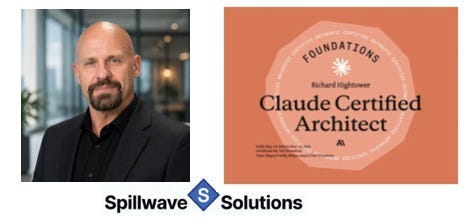
Rick Hightower helps companies become AI-first through practical mentoring, executive and team training, and custom AI solution development. He is a former Senior Distinguished Engineer at a Fortune 100 company, where he focused on bringing ML and AI insights into real front-line business applications.
Subscribe to Rick’s newsletter to see videos and guides.
Rick is a Claude Certified Architect, AI systems practitioner, and builder of production multi-agent systems. He is currently working on authoring a book on Harness Engineering with Manning Publishing. He created Skilz, a universal agent skill installer supporting 30+ coding agents, including Claude Code, Gemini, Copilot, and Cursor, and co-founded one of the largest agentic skill marketplaces.
Today, Rick and the Spillwave team work with leaders and teams who want to move beyond AI experiments and build real AI capability inside their companies. He helps organizations adopt AI safely, train their people, redesign workflows, and build practical AI systems that create measurable business value.
Ready to make your company AI-first? Connect with Rick on LinkedIn, Substack, or Medium, book him to speak or train your team, or visit Spillwave to explore mentoring, training, and custom AI solutions for your organization.