
LangGraph vs CrewAI vs Claude Agent SDK: Which AI Agent Framework Actually Wins in 2026?
Which one do you pick in 2026: LlamaIndex, CrewAI, LangGraph, LangChain, LangChain DeepAgents, Claude Agent SDK, OpenAI Agent SDK, Google ADK, and more

There are dozens of AI agent frameworks. Most teams waste time comparing star counts and marketing claims instead of looking at what each tool is actually good at in production.
This article gives a clear, practical comparison of the major options in mid-2026. It uses live GitHub data from July 27, 2026, real package figures, named production deployments, and how the frameworks actually differ so you can match the tool to the job.
The Six Categories That Matter
The field has consolidated. Almost every serious option falls into one of these six groups:
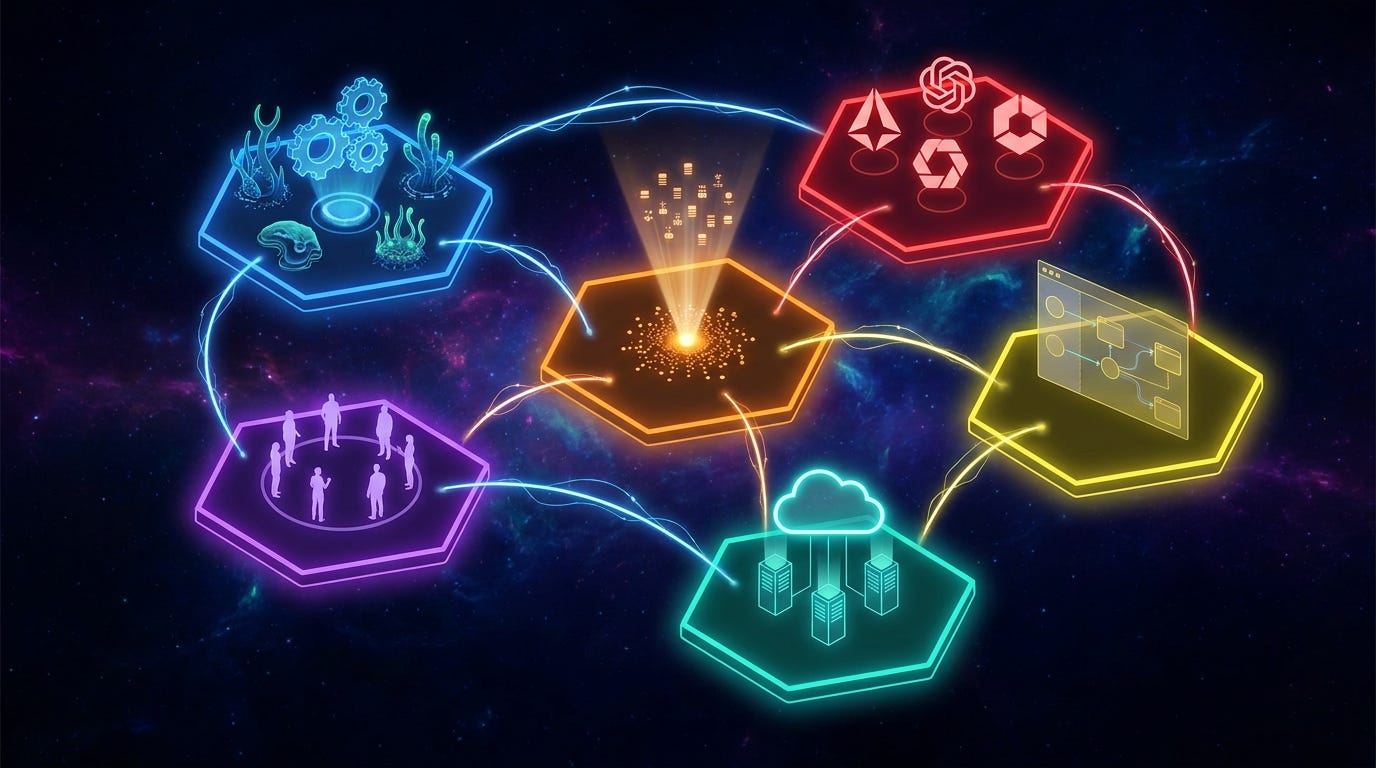
Broad Ecosystem: LangChain + LangGraph + DeepAgents
Specialized Multi-Agent: CrewAI
RAG-Focused: LlamaIndex and Haystack
Provider / Platform SDKs: Claude Agent SDK, OpenAI Agents SDK, Google ADK
Low-Code / Visual Builders: Dify, n8n, Langflow
Managed / Batteries-Included: AWS Bedrock AgentCore, Microsoft Agent Framework, Mastra
Treating them as a single ranked list is how most people make poor decisions. Each category optimizes for different things.
Live Data Snapshot (July 27, 2026)
Selected GitHub stars:
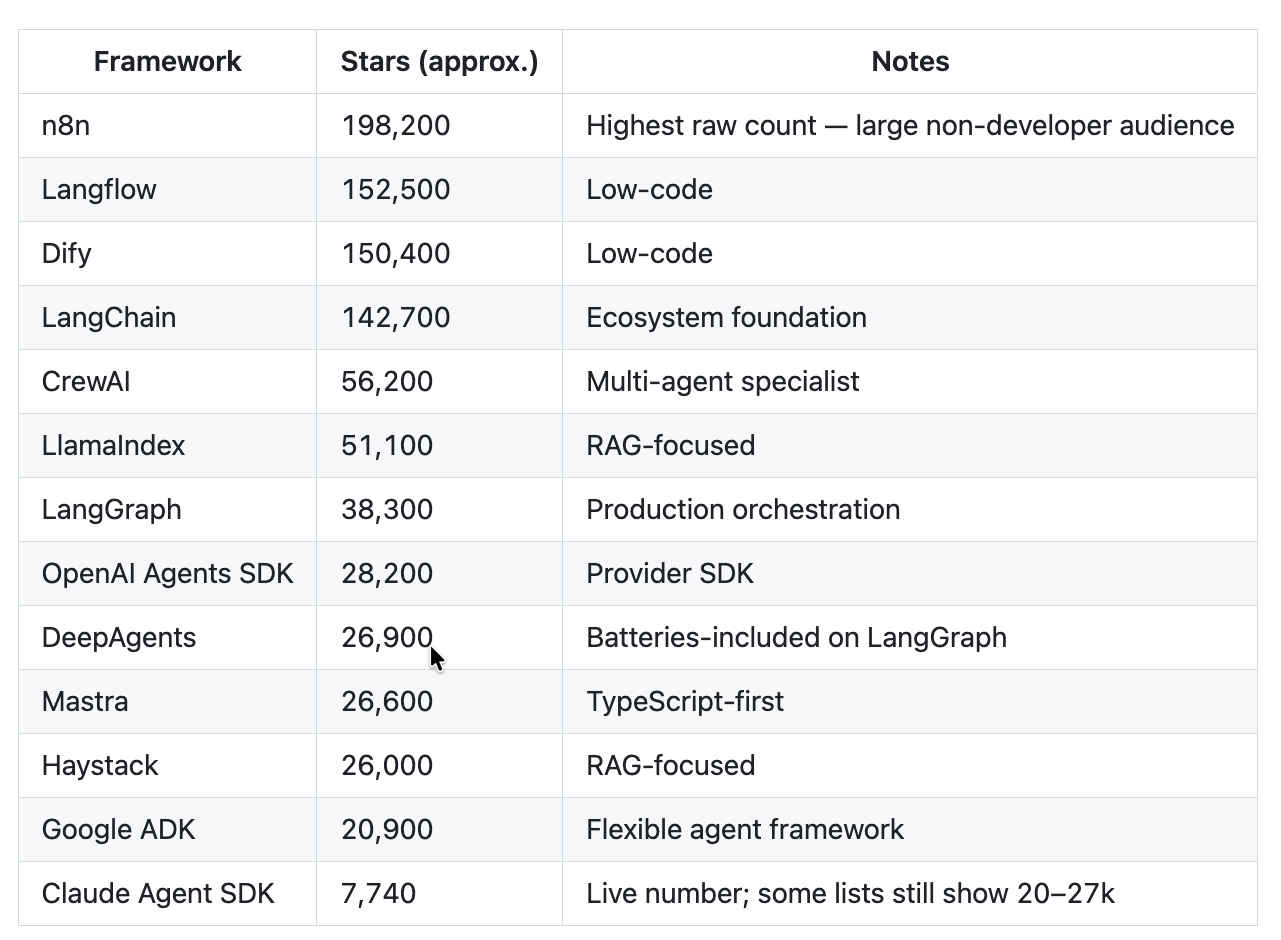
Download context: PyPI and npm counts include CI, Docker, and mirror traffic. They are not unique developer counts. As of July 27: LangChain ~309M 30-day installs, LangGraph ~66.5M, CrewAI ~10.8M, Mastra ~4.9M monthly equivalent.

Stars and downloads show community size and momentum. They are weak signals of production fit, but it often rhymes.
Category Deep Dive
1. Broad Ecosystem: LangChain, LangGraph, DeepAgents
LangChain remains the largest ecosystem. Most tutorials, integrations, and community knowledge still live here.
LangGraph is the production layer. It adds stateful, graph-based orchestration, durable execution, checkpoints, human-in-the-loop interrupts, and streaming. Real agents need to survive failures, persist state across long tasks, and branch conditionally. LangGraph was built for that. LangSmith gives you the observability most teams eventually need.
DeepAgents is the newer batteries-included harness on top of LangGraph. It ships ready-made patterns, async subagents, and multimodal support. Many teams now use the combination: LangGraph for control and durability + DeepAgents for the higher-level harness + LangSmith for tracing. LangChain DeepAgents is LangGraph’s answer to Claude Agent SDK.
Best for: Production stateful agents that need reliability and observability.
Trade-off: Steeper learning curve and more concepts than lighter frameworks.
2. Specialized Multi-Agent — CrewAI
CrewAI focuses on role-based multi-agent systems. You define agents with clear roles, goals, and tools, then assemble them into crews. It is one of the fastest ways to stand up collaborating agents and remains popular for prototypes, internal tools, and research-style agents.
Best for: Rapid multi-agent prototypes and role-based collaboration.
Trade-off: Less native strength in long-running durable workflows and complex state management compared with LangGraph.
3. RAG-Focused — LlamaIndex and Haystack
When retrieval quality and data pipelines are the core problem, these two still lead. They give deeper control over indexing, retrieval strategies, and evaluation than general-purpose agent frameworks.
Best for: Knowledge-intensive agents where RAG quality is the main bottleneck.
4. Provider / Platform SDKs — Claude, OpenAI, and Google ADK
Claude Agent SDK and OpenAI Agents SDK give you a solid agent loop tightly integrated with their respective model families. They are strong choices when you are already committed to Claude or the OpenAI models and want to avoid a large third-party abstraction layer.
Google ADK is a special case and requires an explicit warning.
From ADK 1.x to ADK 2.0, the entire development model changed. Version 2.0 is a graph-based, node-oriented system — agents, tools, and functions become nodes in an explicit execution graph with edges, routing, fan-out/fan-in, loops, and human-in-the-loop support. This is much closer in design to LangGraph than to the earlier hierarchical ADK.
There are real breaking changes (API, event model, and especially session/storage schema). Compatibility between the two generations is limited. Official guidance warns against mixing 1.x and 2.0 storage systems.
On languages: The full graph-based 2.0 runtime is currently GA and most complete in Python and Go. TypeScript, Java, and Kotlin have ADK implementations, but they do not yet offer equivalent parity with the new graph engine. As a result, teams that invested in the 1.x path using TypeScript, Java, or Kotlin currently have no clean same-language upgrade path to the full 2.0 graph model — they would need to wait for broader language parity or switch to Python or Go.
In practical terms, ADK 2.0 has very little real continuity with the earlier ADK beyond the name. Treat them as substantially different frameworks that share a brand. When the programming constructs are completely different, and they don’t support the same programming languages, why does it even share the same name?
On the positive side, ADK remains model-agnostic: it works with any model available through Vertex AI (not just Gemini) as well as external models via connectors such as LiteLLM.
Best for:
Claude / OpenAI SDKs → teams already deep in that model family
Google ADK → teams on Google Cloud / Vertex who want model flexibility and are prepared to adopt the completely different 2.0 graph model (and, if coming from TypeScript/Java/Kotlin 1.x, potentially a language change)
5. Low-Code / Visual Builders — Dify, n8n, Langflow
These tools have the highest star counts because they attract a much broader audience, including non-engineers. They excel at rapid internal tools and workflows that need to be maintained by mixed teams.
Best for: Speed, accessibility, and non-engineer stakeholders.
Trade-off: Usually the wrong primary choice when you need fine-grained control, complex state, or heavy custom logic.
6. Managed / Batteries-Included — AgentCore, Microsoft Agent Framework, Mastra
AWS Bedrock AgentCore is infrastructure. You bring your own agent code and get managed runtime, memory, gateway, observability, and sandboxing.
Microsoft Agent Framework provides orchestration, handoffs, and Azure integration.
Mastra is the strongest TypeScript-first, batteries-included framework right now (agents, workflows, memory, observability, Studio, model router).
Best for: Teams that want to skip plumbing or are already committed to AWS / Azure / TypeScript.
If you are a paid subscriber, thank you. Your support makes this work possible.
If you are a free subscriber and find these articles useful, please consider upgrading. A paid subscription is $80 per year or $8 per month.
Free subscribers typically receive access to the full versions of paid articles after one to two months.
