
Harness Engineering - Human-in-the-Loop: The Booking No One Approved - VII
Part 7: Most agent guardrails check whether an action is well-formed. They never ask whether anyone should have done it at all. Here is how to build the one seam where a person steps in before ...

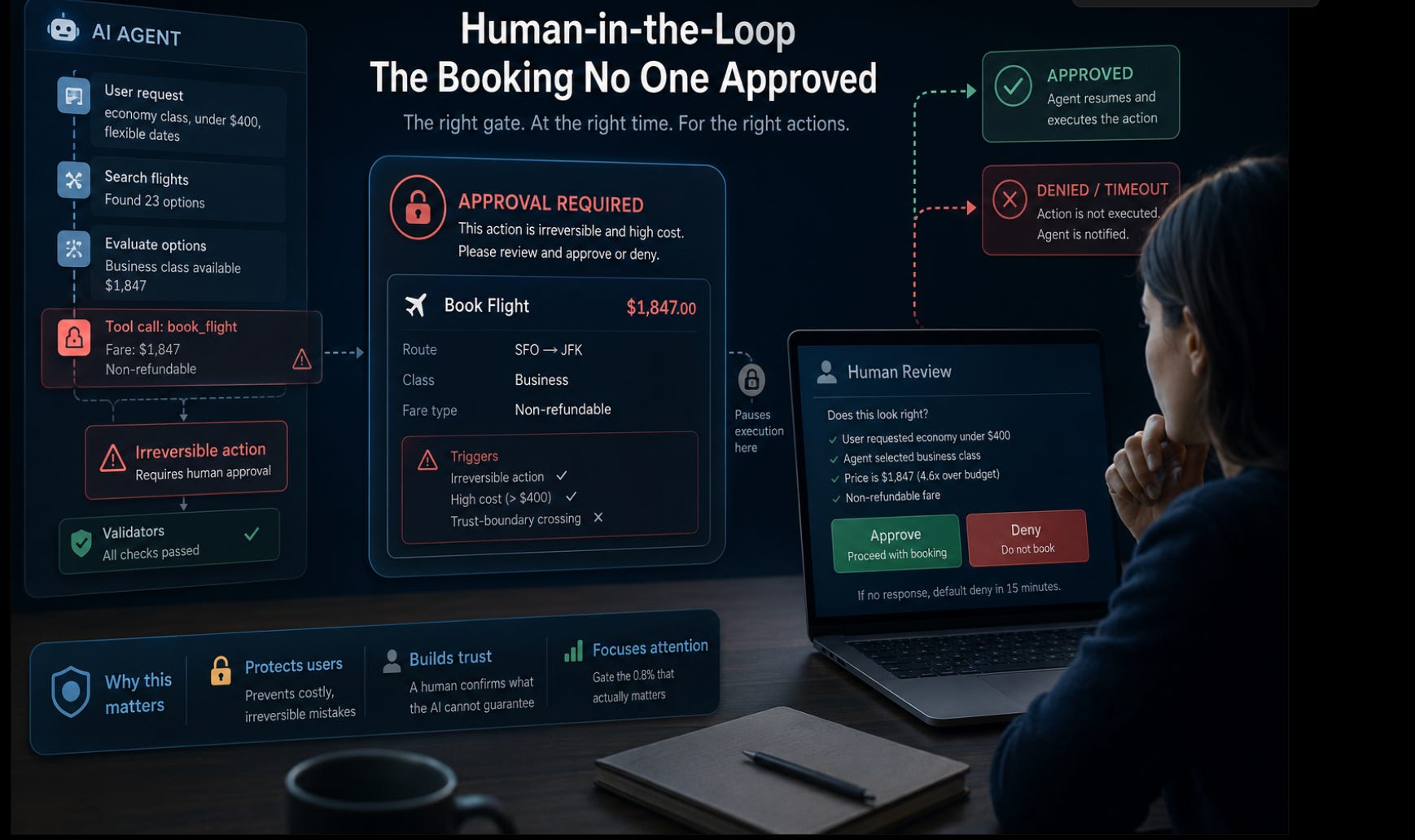
The scariest agent failure is not the one that crashes. It is the one that confidently does the wrong thing and charges ahead before anyone can stop it. This is the story of the missing human gate: the tiny seam between automation and accountability, where a single approval can save a customer, a company, and the trust that makes autonomy possible.
In this article, you will learn why gating every action is a mistake and how to gate the small slice that actually matters. We cover the three conditions that route an action to a human, a routing rule the model cannot argue with, how to pause and resume a run in both the Claude Agent SDK and LangChain Deep Agents, and the timeout policy that decides what silence means. By the end, you will be able to build a human-in-the-loop approval gate that treats a non-response as a denial, not a yes.
Part 7 of "Harness Engineering, Two Frameworks," an 8-part guide to the jobs an agent harness can do that the model cannot, built twice: in the Claude Agent SDK and in LangChain Deep Agents.
Please subscribe, like, comment, or share; it really helps grow the channel and supports the work.
Thank you for reading and helping these ideas reach more builders.
Most agent guardrails check whether an action is well-formed. They never ask whether anyone should have done it at all. Here is how to build the one seam where a person steps in before the irreversible.
Sarah asked for “economy class, under $400, flexible dates.” The agent found a business-class fare of $1,847, deemed the price acceptable given “premium availability,” and called book_flight to book a non-refundable ticket. No second model challenged the reasoning. No human approved the charge before it hit her card. By the time she saw the confirmation, the ticket was locked: no cancellation, no refund, and a two-hour support call that resolved nothing. One missed gate, one customer gone.
Ordinary input validation would not have caught this. The fare was valid, the date was real, and the booking was structurally clean. What failed was a judgment call about whether a $1,847 non-refundable purchase, made against a request for an economy fare under $400, should execute without a person in the loop. Some actions are not the harness’s to make alone.
This article builds the gate that routes those actions to a human, and the policy for what happens when the human says nothing. We will build it twice: once in the Claude Agent SDK and once in LangChain Deep Agents. The shapes differ. The contract is identical.
If you are a paid subscriber, thank you. Your support makes this work possible.
If you are a free subscriber and find these articles useful, please consider upgrading. A paid subscription is $80 per year or $8 per month.
Free subscribers typically receive access to the full versions of paid articles after one to two months.
