
DeepEval: The Loop Closes: AI Coding Agent Evaluation Becomes Concrete
DeepEval 4.0 turns the missing verifier into an installable harness—giving coding agents the structured feedback they need to inspect failures, patch precisely, and close the loop.

Why the Verifier Is the Hard Part
Agents can already write code. That was never the hard part.
The hard part is whether the system can tell the agent why the output is wrong, in a form the agent can actually act on. Pass/fail is not enough. The agent needs to know which step failed, which metric tripped, and why the metric fired. Without that, every correction is a guess.
DeepEval 4.0 is a concrete answer to that problem. It is an open-source evaluation harness, think of it as a test harness purpose-built for AI coding agent output, and it ships the CLI commands needed for Claude Code, Cursor, and OpenAI Codex to use it (DeepEval 4.0 announcement). Confident AI, the company behind it, names the approach deliberately in the 4.0 announcement: “This is why we call DeepEval 4.0 the evaluation ‘harness’ — it is the scaffolding that stops your vibe coding agents from vibe coding.”
You can install it today: pip install deepeval. The source lives at github.com/confident-ai/deepeval.
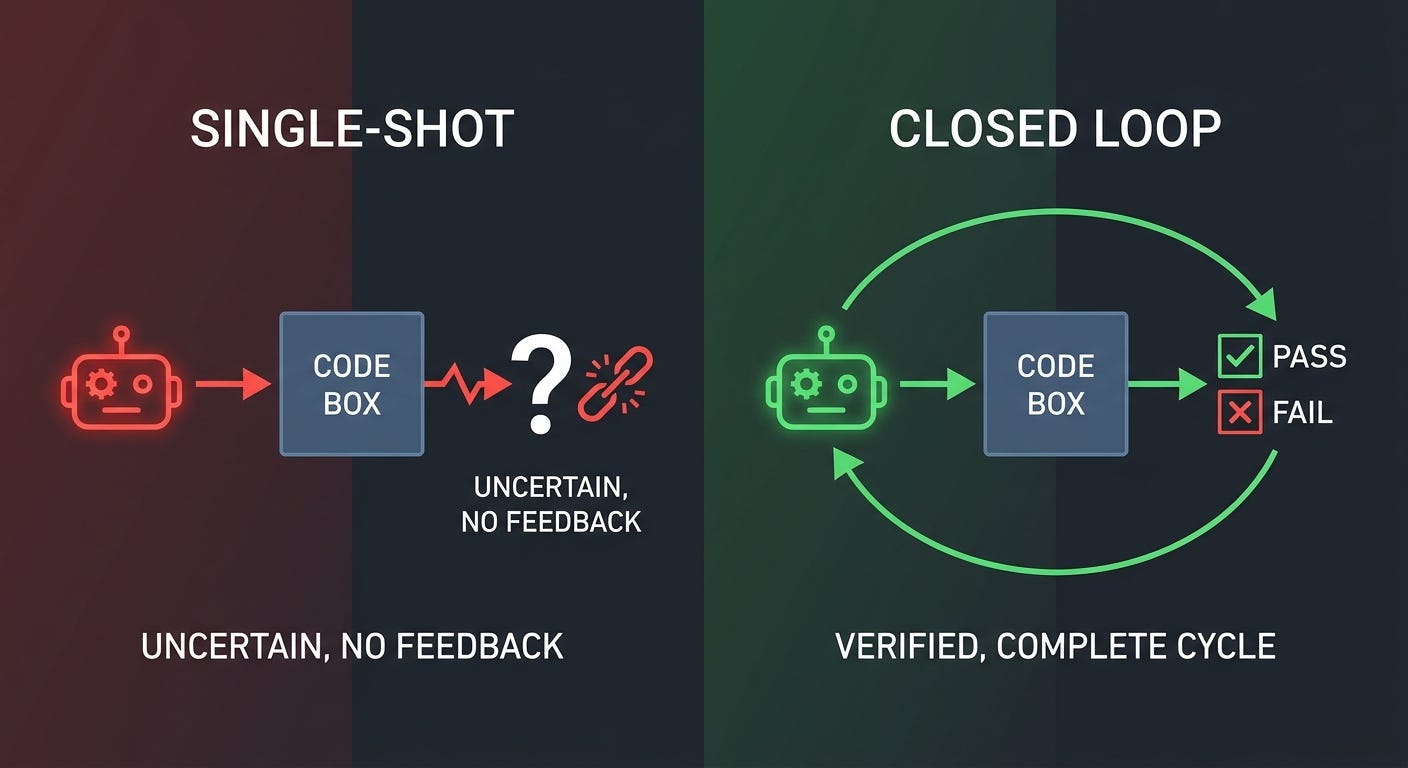
DeepEval 4.0 is loop engineering made concrete. Not an abstract design principle. An installable verifier. A real, runnable piece of infrastructure that closes the build-evaluate-patch-rerun cycle instead of leaving a gap where human eyeballing used to be.
The genuine shift is not that coding agents got smarter. It is that the tooling around them finally caught up to what a production loop actually needs. A verifier is not optional in a real loop. Without one, you do not have a loop; you have a single-shot prompt with optimism attached.
DeepEval 4.0 supplies the verifier.
If you are a paid subscriber, thank you. Your support makes this work possible.
If you are a free subscriber and find these articles useful, please consider upgrading. A paid subscription is $80 per year or $8 per month.
