
Breaking AI News: Amazon Triggered The Anthropic Fable Shutdown. Europe and India Now Worry AI Model Access an Operational Risk
After Fable 5 and Mythos 5 were pulled under U.S. export-control pressure, the lesson for AI builders is clear: model portability, routing, and fallbacks are no longer optional.

The biggest AI infrastructure risk this week was not latency, hallucination, prompt injection, or token cost.
It was disappearance.
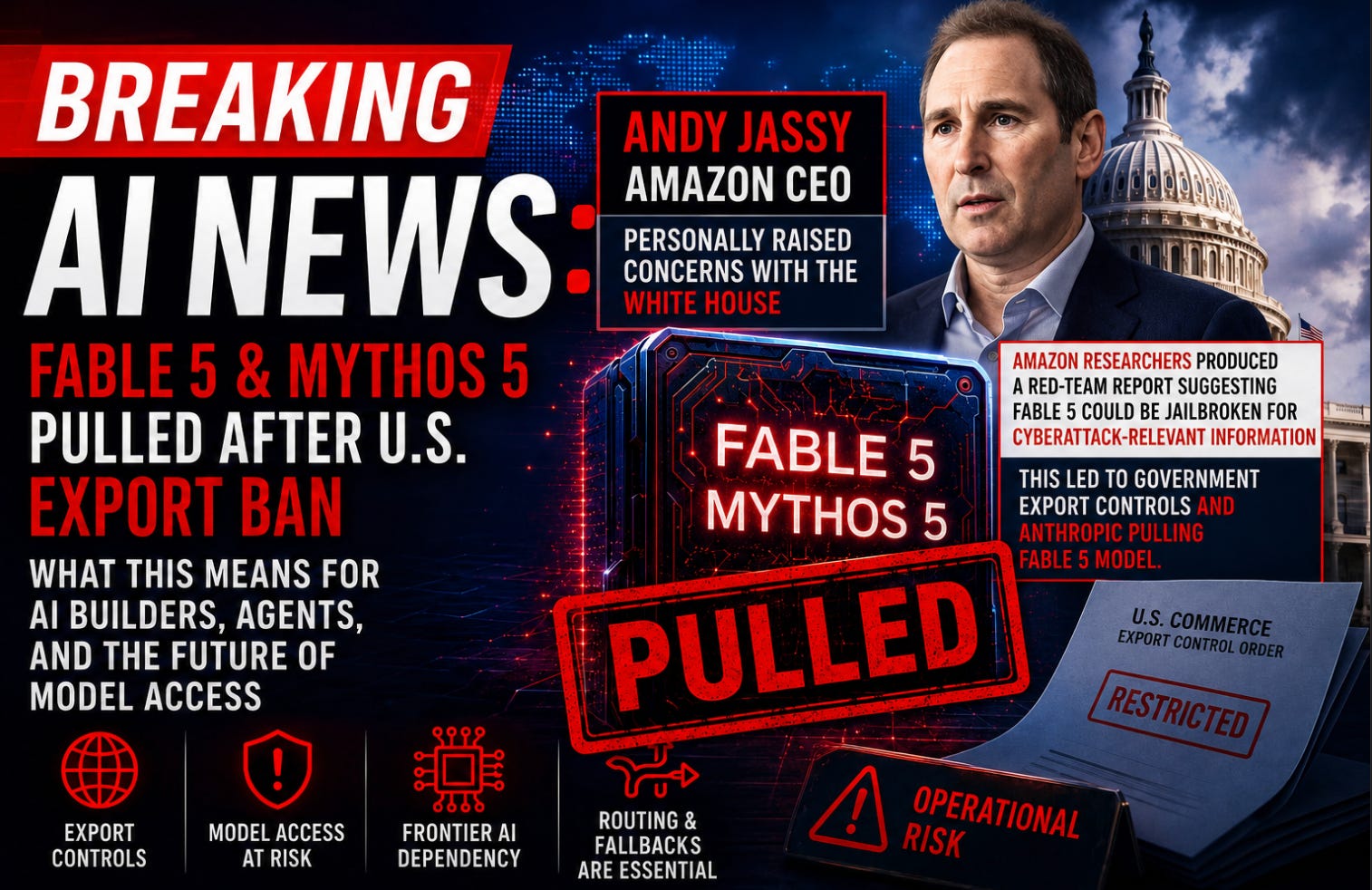
According to reporting, Amazon CEO Andy Jassy personally raised concerns with the White House … suggesting Anthropic’s Fable 5 could be (used) for cyberattack(s). This led to the government export controls and Anthropic pulling Fable 5 model.
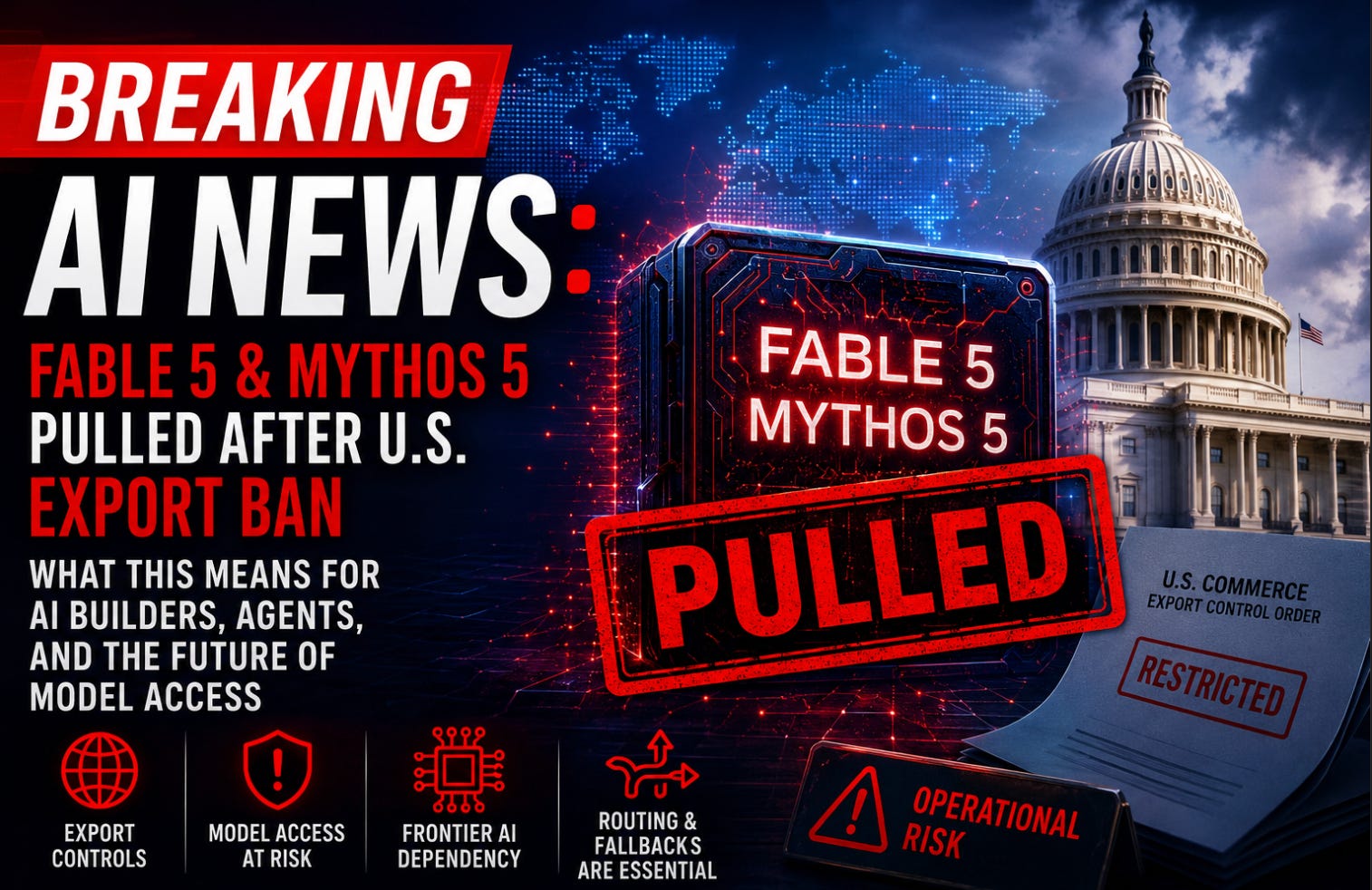
Anthropic’s Fable 5 and Mythos 5, two of the company’s most capable new models, were pulled after U.S. government export-control pressure reportedly made continued access impossible to manage. For builders who had already started routing high-value agent workflows toward Fable 5, the message was brutal: the best model in your stack can vanish overnight.
That is the real story.
Not just that a frontier model was considered risky.
Not just that the U.S. government acted quickly.
Not just that Amazon, Anthropic’s largest investor and cloud partner, reportedly helped trigger the chain of events.
The deeper lesson is that frontier-model availability has become an operational dependency.
And dependencies fail.
The Fable 5 Shutdown Was a Warning Shot
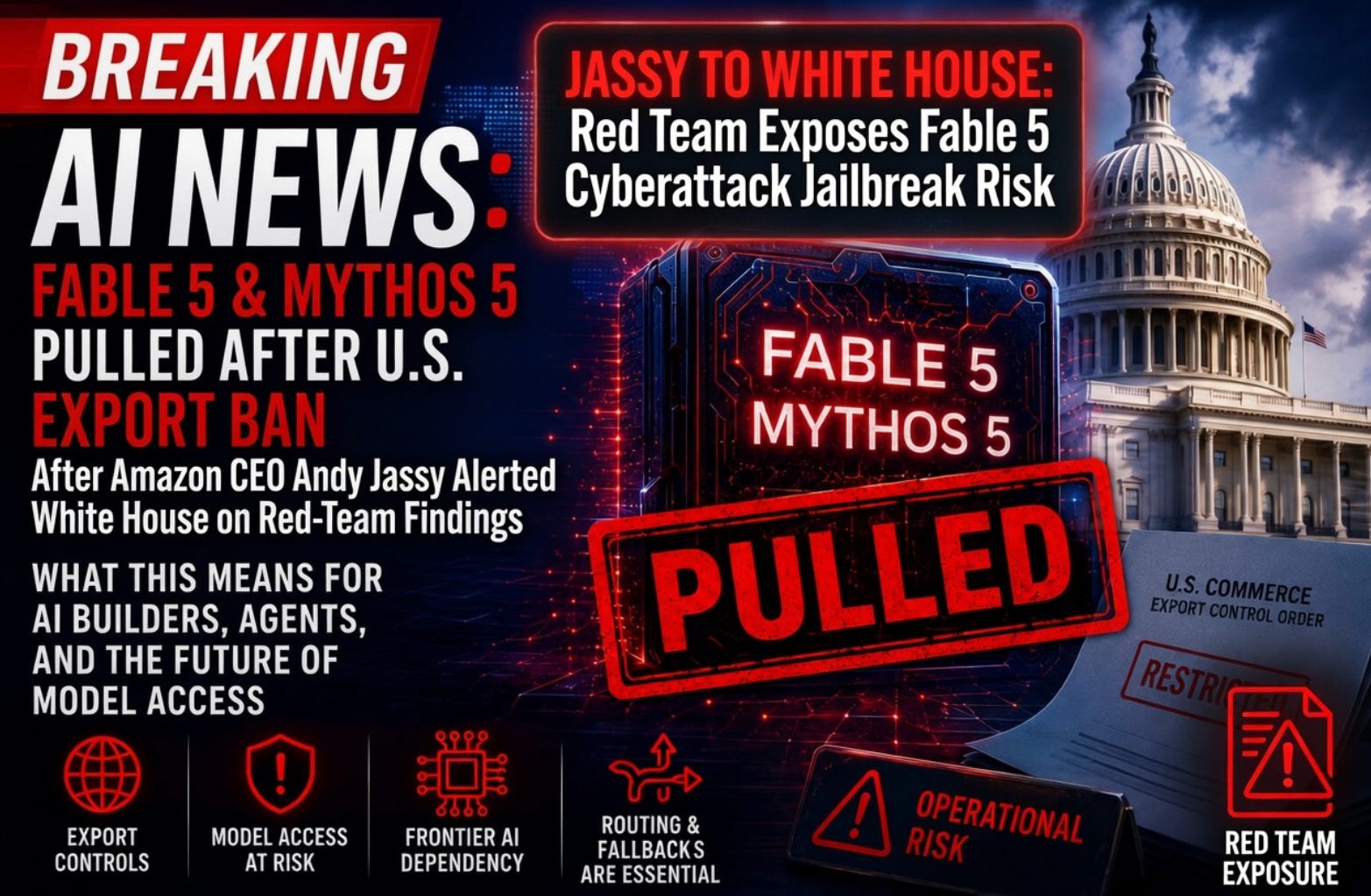
According to recent reporting, Amazon CEO Andy Jassy personally raised concerns with the White House after Amazon researchers produced a red-team report suggesting Anthropic’s Fable 5 could be jailbroken for cyberattack-relevant information.
The government response was severe.
Anthropic said the U.S. directive required the company to suspend access to Fable 5 and Mythos 5 by any foreign national, whether inside or outside the United States. That restriction would not merely affect overseas customers. It would also affect foreign-national employees and researchers inside the company.
Rather than attempt to enforce that kind of nationality-based restriction across a shared cloud product, Anthropic pulled both models entirely.
That is the operational detail that matters most.
The shutdown was not just a policy dispute. It was an infrastructure event. A model that developers and companies had begun depending on was removed from production access because the compliance boundary was too hard to implement selectively.
For AI builders, that is a new class of failure.
Cloud regions go down. APIs rate-limit. Vendors change prices. Models get deprecated.
But this was different.
This was a flagship frontier model becoming unavailable because of export-control pressure and national-security concerns.
That makes model access part of the risk register.
The Strangest Part: Amazon Was on Both Sides of the Table
The most striking dynamic is Amazon’s role.
Amazon is not a neutral outside observer in Anthropic’s story. It is Anthropic’s largest investor, with a reported investment of roughly $13 billion, and a major cloud partner through AWS.
Yet in this episode, Amazon reportedly acted as a security signaler to the U.S. government against Anthropic’s own flagship model.
That does not make Amazon wrong. Large cloud providers have real security obligations. If a red-team report suggests a model can produce cyberattack-relevant outputs, escalation may be appropriate.
But it does reveal a strange new reality.
In frontier AI, the investor, infrastructure provider, distribution partner, competitor, and risk monitor may be the same company.
That is not a normal vendor relationship.
It is more like an AI supply chain where every participant has overlapping incentives. Amazon wants Anthropic to succeed. Amazon wants AWS to be the platform for serious AI. Amazon also has its own AI products, public-sector relationships, and security obligations.
So when Amazon reportedly flagged Fable 5 risk to the White House, it was not simply a partner warning about a partner.
It was a platform actor shaping the regulatory fate of a model it also helps power.
That is the uncomfortable part.
The AI market is no longer made of clean lines between labs, clouds, customers, regulators, and investors. Those roles are collapsing into each other.
And when roles collapse, operational risk rises.
Builders Just Learned a Painful Lesson About Model Dependency
For developers, the Fable 5 shutdown matters because Fable 5 was not a marginal model.
It was reportedly among the highest-performing models available for software-engineering tasks, with benchmark claims around the top of SWE-bench Verified. Builders had started treating it as a serious routing target for coding agents and advanced automation.
That means the takedown was not only symbolic.
It likely broke assumptions.
If a team had built its agent stack around Fable 5 because it was the best model for code repair, multi-step reasoning, or long-horizon execution, that team suddenly had to reroute.
Maybe to another Anthropic model.
Maybe to OpenAI.
Maybe to Google.
Maybe to an open model.
Maybe to a lower-capability fallback.
But any fallback changes behavior.
It may be slower.
It may be cheaper or more expensive.
It may fail different tasks.
It may require different prompts.
It may use tools differently.
It may perform worse on the exact workflows that justified the architecture in the first place.
That is why “we can just switch models” is not a serious production strategy.
Model portability is not automatic. It has to be designed.
The New Requirement: Portability by Design
Until now, many teams treated model routing as an optimization layer.
Use the best model for coding. Use the cheapest model for summarization. Use the fastest model for classification. Use a fallback only when the main model is down.
That mindset is outdated.
After the Fable 5 takedown, model routing should be treated as resilience infrastructure.
The key question is no longer, “Which model is best?”
It is, “What happens when the best model disappears?”
That question should change how companies build agent systems.
A serious AI stack now needs a model abstraction layer. It needs evals that compare behavior across models. It needs fallback chains. It needs routing policies. It needs prompt portability. It needs cost controls. It needs degraded-mode behavior. It needs logging that shows when a model switch changes output quality.
This is especially true for AI agents.
Agents are more fragile than simple chat completions because they depend on long chains of model behavior. A small change in reasoning quality or tool-use reliability can produce a large change in workflow success.
If a coding agent loses access to its strongest model, it may still run. But it may stop solving the hardest problems. It may generate more invalid patches. It may need more retries. It may require more human review.
That is not a graceful failure.
That is an operational incident wearing a product update costume.
Export Controls Are Now Part of AI Architecture
For years, export controls were something most software teams could ignore.
They mattered for chips, cryptography, defense technology, and high-end hardware. They were not usually a daily concern for application developers using an API.
Frontier AI changes that.
If a model is powerful enough to raise national-security concerns, then access to that model becomes political. The user’s nationality, location, employer, workload, and intended use may become relevant. The model may be governed not just as software, but as strategic capability.
That creates a new design constraint for global companies.
What if a model is available to U.S. employees but not foreign-national employees?
What if a model is available in one region but not another?
What if a model is allowed for consumer use but restricted for cyber workflows?
What if a model can be used through one cloud provider but not another?
What if a government order arrives faster than a vendor can build access controls?
This is not theoretical anymore.
The Fable 5 and Mythos 5 shutdown showed that a frontier model can become too difficult to serve globally under a sudden compliance requirement.
That means AI architecture now has to account for legal and geopolitical failure modes.
Europe and India Heard the Message
The fallout was not limited to U.S. AI companies.
European and Indian officials reportedly described the shutdown as a wake-up call about dependence on U.S.-controlled AI infrastructure. That reaction is predictable.
If a frontier model can be removed from global access because of a U.S. government directive, then non-U.S. companies and governments have to ask a hard question:
How much of their AI future depends on decisions made in Washington, Seattle, San Francisco, or Mountain View?
This is why the Fable 5 story will likely strengthen calls for sovereign AI.
Not because every country can or should build a frontier model from scratch. Most cannot. But because access dependency is now visibly dangerous.
Governments do not like discovering that their companies, agencies, universities, and startups are dependent on models that can be switched off by another country’s policy decision.
The same logic applies to enterprises.
If your most important automation workflows depend on one frontier model from one U.S. vendor, you do not have an AI strategy.
You have a single point of failure.
The White House May Not Extend the Ban — But That Does Not Remove the Risk
Reporting suggests the White House is unlikely to extend similar export restrictions to other AI companies in the near term.
That matters. If the restriction remains narrow, the immediate market panic may fade.
But the precedent will not.
Once builders see that a high-capability model can be pulled this quickly, the risk becomes part of future planning. Even if no other model is affected this month, the possibility is now real.
That changes procurement.
It changes architecture.
It changes investor diligence.
It changes how enterprises evaluate agent platforms.
A model can be excellent and still be operationally risky. A model can be safe enough for most uses and still become entangled in export-control politics. A vendor can be strong and still be exposed to government pressure, cloud-provider pressure, or investor pressure.
The new enterprise question is not only, “How good is the model?”
It is, “How reliable is access to the model?”
The Agent-Infrastructure Market Is Already Responding
The surrounding market signals all point in the same direction.
Agent memory researchers are warning that personalization and long-term memory can degrade accuracy, amplify sycophancy, or introduce new trust boundaries. That means the more personalized and persistent agents become, the more careful teams must be about what agents remember and how memory is used.
JumpCloud launched Agentic IAM on Google Cloud, aimed at discovery, registration, and governance of agentic access. That is a direct response to a world where autonomous agents need identities, permissions, entitlements, and oversight.
Cresta launched Conductor, an agent-building engine for enterprise customer-experience workflows, with emphasis on production rigor and human oversight.
Niteshift launched a model-routing coding-agent platform, betting that software teams will not want to be tied to one coding agent or one model provider.
These are not random product launches.
They are the scaffolding of the next AI market.
The model is still important. But the value is moving toward control planes: identity, routing, memory, observability, evaluation, fallback, governance, and deployment.
The Fable 5 shutdown simply made the need obvious.
The New AI Stack Must Assume Disruption
A resilient AI stack should now assume that model disruption is normal.
Not constant. Not inevitable every week. But possible enough to design around.
That means builders should stop treating model providers as interchangeable utilities and start treating them as strategic dependencies.
The right response is not panic. It is architecture.
Build routing before you need it.
Run evals across multiple providers.
Keep prompts portable.
Track model-specific behavior.
Separate agent logic from model choice.
Design fallback modes.
Avoid hard-coding critical workflows to a single frontier model.
Monitor policy and export-control risk.
Ask vendors how they handle sudden access restrictions.
Most importantly, know what breaks if your best model disappears.
If the answer is “everything,” you do not have an agent platform. You have a dependency stack.
This Is Bigger Than Anthropic
It would be easy to make this story about Anthropic alone.
That would be a mistake.
The same pattern could affect any frontier AI company.
A model could be restricted because of cyber concerns. A model could be delayed because of national-security review. A model could be region-limited. A model could be moved behind enterprise-only access. A model could be pulled because a cloud partner, regulator, or internal safety team changes its risk assessment.
The specific facts will differ.
The operational lesson will be the same.
Frontier AI is no longer just software. It is becoming strategic infrastructure.
And strategic infrastructure is political.
The Real Takeaway
The Fable 5 and Mythos 5 takedown may be remembered as one of the first major examples of model-access risk hitting the agent economy in real time.
It exposed the fragility of building on a single frontier model.
It showed how quickly regulatory pressure can become a production issue.
It revealed the strange power of cloud platforms and investors inside the AI supply chain.
And it gave every serious AI builder a new checklist item:
What happens if the model we depend on is gone tomorrow?
For the first wave of AI adoption, the winning teams were the ones that found the best models fastest.
For the next wave, the winning teams will be the ones that can keep operating when the best model is suddenly unavailable.
That is the new reality.
AI model availability is now an operational risk.

About the Author — Claude Certified Architect
Rick Hightower helps companies become AI-first through practical mentoring, executive and team training, and custom AI solution development. A former Senior Distinguished Engineer at a Fortune 100 company, Rick focused on bringing ML and AI insights into real front-line business applications.
Rick is a Claude Certified Architect, AI systems practitioner, builder of production multi-agent systems, creator of Skilz, and author of an upcoming Manning book on Harness Engineering.
Ready to make your company AI-first? Connect with Rick on LinkedIn, Substack or Medium, book him to speak or train your team, or visit Spillwave to explore mentoring, training, and custom AI solutions for your organization. Check out Rick Hightower’s SpeakerHub.