
AWS AgentCore vs. Gemini Agent Platform vs. Azure AI Foundry: The Hyperscaler Agent Platform Comparison
What AWS AgentCore, Gemini Agent Platform, and Azure AI Foundry each give you for hosting, memory, code execution, tool gateways, and observability, and where each one wants to lock you in.

You're about to bet your next two years of engineering on one of three agent platforms that all look identical from the outside. The differences that actually matter are buried under marketing, and this is the honest, side-by-side map of what each hyperscaler really gives you, what's still half-baked, and where each one quietly wants to lock you in.
Why this matters now
A year ago, shipping a production agent meant building the plumbing yourself. You stood up your own retrieval pipeline for RAG, your own conversation and session servers, your own tool-calling glue, your own sandboxed code execution, and your own tracing. Every team reinvented the same five layers, and the agent itself was maybe a third of the work.
This has changed. AWS, Google Cloud, and Microsoft Azure have absorbed that plumbing into managed agent platforms, and crucially, they integrate with the frameworks you already use. You keep your LangGraph graph, your DeepAgents harness, or your Claude Agent SDK loop, and you plug it into managed hosting, durable memory, sandboxed code execution, a governed tool and MCP gateway, and observability that survives the request. The brain is yours; the plumbing is theirs.
The interesting part is the harness. An advanced orchestration harness is no longer something you write and operate yourself; it hooks up to the hyperscaler, which runs the loop, isolates each session, and hands back deploy-ready agent capabilities. This is the deal on offer across all three clouds, and it is why the choice of platform may matters as much as the choice of framework.
This article compares what AWS AgentCore, Gemini Agent Platform, and Azure AI Foundry actually give you across those shared layers, where the integrations land for LangGraph, DeepAgents, and the Claude Agent SDK, and where each cloud quietly wants to lock you in.
Before we get into it, please consider subscribing to my Substack newsletter.
If this kind of practical, production-minded AI work is useful to you, a subscribe, like, comment, or share really helps grow the channel and supports the work.
Thank you for reading and helping these ideas reach more builders.
Hyperscaler AI Agent Platforms: AWS, Google Cloud, and Microsoft Azure Compared
A side-by-side engineering comparison of the managed infrastructure stacks for hosting, memory, code execution, tool/MCP gateways, and observability for custom-coded AI agents, with integration patterns for LangGraph/LangChain, LangChain DeepAgents, and the Claude Agent SDK.
Executive Summary: AWS vs. Google Cloud vs. Azure Agent Platform Differences
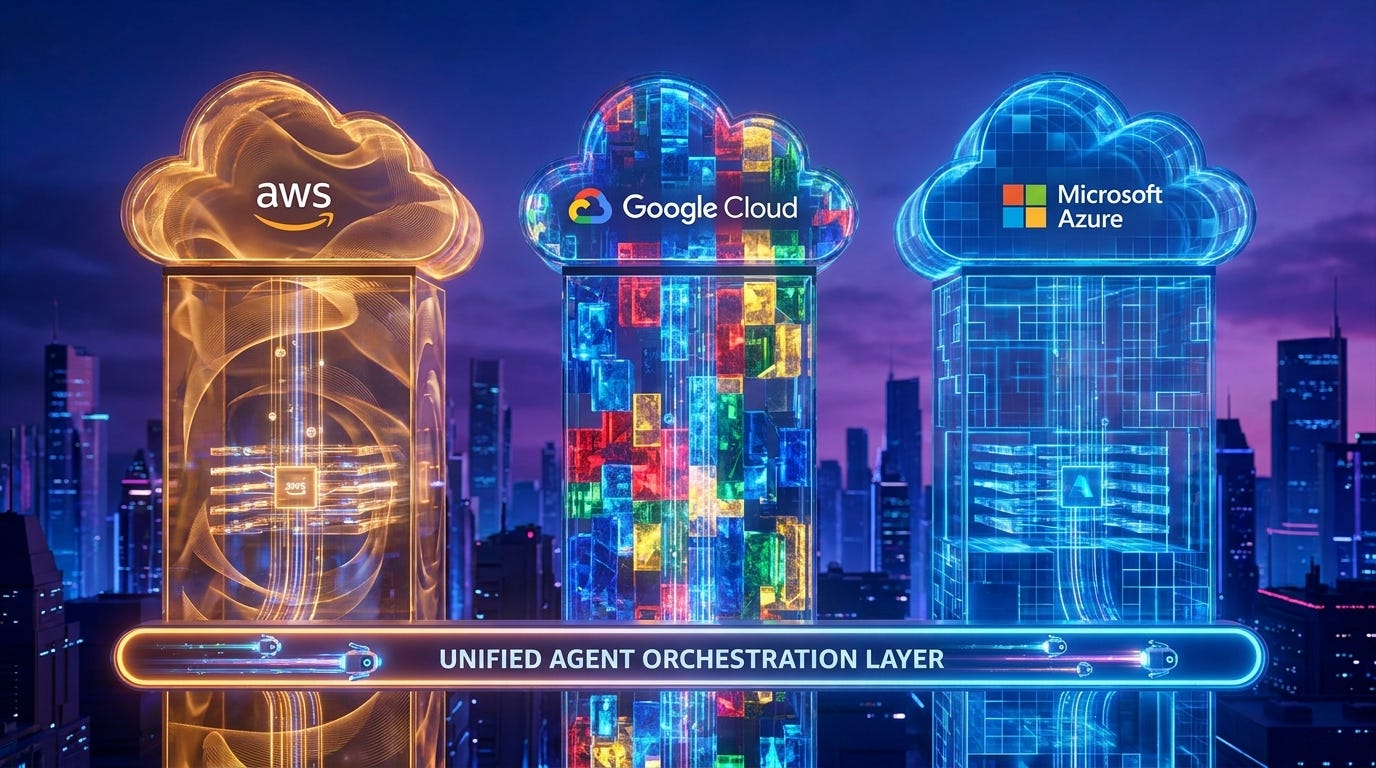
Pick the wrong cloud for your AI Agents and you spend the next two quarters fighting the platform instead of shipping the product. All three hyperscalers now ship a managed “agent platform” that decouples the brain (your chosen agent framework: LangGraph, LangChain, ADK, CrewAI, Strands, the Claude Agent SDK) from the plumbing (compute, memory, code sandbox, tool gateway, identity, observability). Same job, three very different toolboxes.
If you are a paid subscriber, thank you. Your support makes this work possible.
If you are a free subscriber and find these articles useful, please consider upgrading. A paid subscription is $80 per year or $8 per month.
Free subscribers typically receive access to the full versions of paid articles after one to two months.
