
AI News, Volume 13: Loop Engineering Gets Its Canon
LangChain, OpenAI, Anthropic, MIT, Microsoft, and Claude Code all point in the same direction: agents are becoming engineered loops with memory, stop rules, observability, identity, and measured work

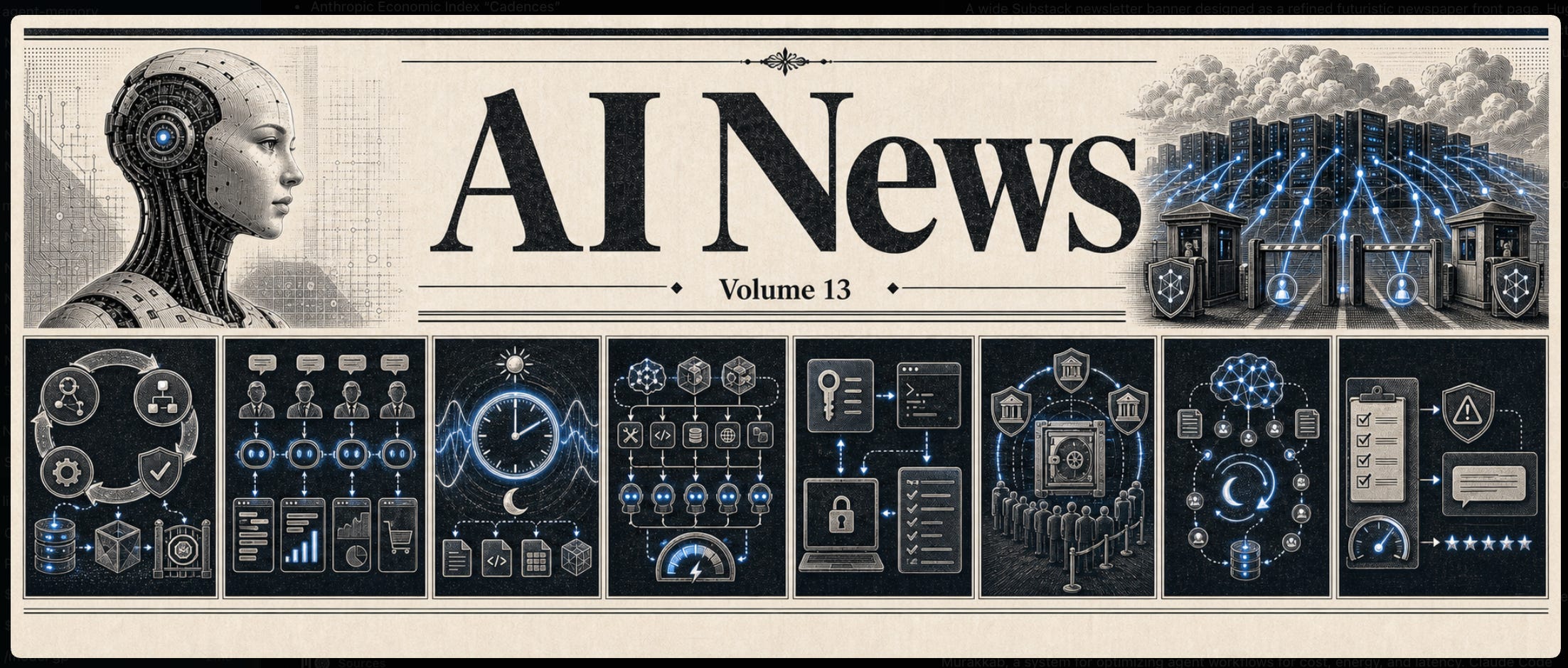
Loop engineering moved from a useful phrase to a visible discipline this weekend. LangChain published “The Art of Loop Engineering,” while developer commentary and curated harness-engineering resources turned the concept into a practical vocabulary: triggers, topology, stop rules, verification, observability, and durable state. OpenAI published internal data showing Codex-style agents replacing chat across departments, while Anthropic’s Economic Index mapped AI usage to work cadences and rising expectations for automation. MIT and Microsoft introduced Murakkab, a system for optimizing agent workflows for cost, energy, and latency. Claude Code added enterprise MCP login and Okta-managed connector provisioning. Anthropic’s Mythos 5 returned in a restricted form for trusted U.S. institutions, and GPT-4.5’s retirement from ChatGPT underscored the accelerating risk to model lifecycles.
Today’s AI News Stories
LangChain makes loop engineering explicit
LangChain published “The Art of Loop Engineering,” a practitioner-oriented framework for designing self-correcting agent systems. The piece frames the real engineering task as building the system around the model: triggers, topology, stop rules, tool surfaces, context, sandboxes, routing, observability, and persistence.
The core loop is simple but consequential: discover, plan, execute, verify, and repeat. That framing is more useful than treating agents as long prompts. It forces builders to define when a loop begins, what state it carries, which tools it can use, how it verifies work, and when it must stop.
LangGraph 1.0 is positioned as the runtime for that style of work, with durable state, persistence, and human-in-the-loop middleware. Those details matter because production agents do not always finish within a single request. They need checkpoints, restart behavior, review gates, and traceability.
The broader developer ecosystem is converging around the same vocabulary. Loop engineering is becoming the operating language for multi-step agents, much the way DevOps became the language for deployment and operations. That does not make it magic; it makes the discipline teachable, reviewable, and eventually hireable.
OpenAI says agents have displaced chat across its own work
OpenAI published internal data on how agents are changing work inside the company. The report says Codex adoption increased sharply compared with November 2025, with growth of 56× in Research, 32× in Customer Support, 27× in Engineering, and 13× in Legal.
The important claim is not that usage went up. Agents have become the primary mode of AI interaction across departments. Engineering adopted first, then functions such as Legal, Finance, and Recruiting crossed the same threshold around April 2026.
That is a meaningful rollout pattern for enterprises. Agent adoption starts where the work is closest to code and tools, then expands into specialized operational functions once teams learn how to wrap agents with policy, context, and review.
The report also reinforces the central theme of this issue: the shift is from chatbot interaction to agent execution. A chatbot answers. An agent works through a loop, uses tools, produces artifacts, and needs operational controls.
Anthropic’s Economic Index maps AI to work cadences
Anthropic published the sixth Economic Index report, “Cadences,” linking survey responses to actual Claude usage data. The report finds that Claude follows daily and weekly patterns, with work-related queries dropping on weekends and different weekend behavior emerging among Claude Code users.
The report says 93% of conversations produce a deliverable such as code, a document, or an explanation. It also finds automation rising in technical domains, including backend architecture and API debugging.
The most quoted number will likely be expectation-based: more than one-third of surveyed users expect AI to do most or nearly all of their work within 12 months. That is not the same as proof that it will happen, but it does show where user expectations are moving.
For infrastructure teams, the cadence data matters. Agent workloads are not flat chatbot traffic. They follow work rhythms, weekend project patterns, long-running coding sessions, and higher-token technical tasks. Capacity planning, observability, and product packaging need to account for those rhythms.
Murakkab optimizes agent workflows for cost, energy, and latency
MIT and Microsoft introduced Murakkab, a system for auto-optimizing agentic workflows. Developers describe a workflow in high-level natural language, and the system chooses models and tools, determines whether steps should run in parallel or sequence, and adapts hardware allocation at runtime.
The reported results are substantial: Murakkab used about 35% of the compute, 27% of the energy, and less than 25% of the cost of baseline approaches while meeting user-specified latency and accuracy constraints.
This is a systems-level answer to a practical problem. Many agent workflows are currently hand-built DAGs with fixed model choices and fixed execution structure. That can work for prototypes, but it wastes compute when workloads vary.
Murakkab treats agent execution as a scheduling and resource-allocation problem. That is where large-scale agent operations are heading. The harness will not merely call a model; it will decide which model, tool, sequence, parallel branch, and hardware path best satisfy the task constraints.
Claude Code moves MCP authentication into enterprise identity
Claude Code added claude mcp login and claude mcp logout, allowing users to authenticate to configured MCP servers directly from the shell instead of going through the interactive menu. That helps developers and CI/CD environments where command-line auth is the natural path.
More importantly, Anthropic enabled centralized MCP authorization across Claude chat, Claude Code, and Cowork through Okta. Admins can provision MCP connectors for an organization through the identity provider, rather than leaving every developer to configure tool access independently.
That is the bridge between MCP as a developer protocol and MCP as an enterprise infrastructure. Agents need tool access, but enterprises need that access to be provisioned, revoked, audited, and scoped through normal identity systems.
Claude Code’s Trusted Devices beta points in the same direction. Remote Control sessions may require enrolled devices before a user can view or steer a local coding session. As agents gain more authority over local tools and repositories, account-level login is not enough; device trust becomes part of the control plane.
Mythos 5 returns through a restricted, trusted-partner gate
The U.S. government cleared Anthropic to release Claude Mythos 5 to more than 100 U.S. institutions, including companies and government agencies, after a period of restricted access. The authorization applies to trusted partners with safeguards in place; Fable 5 remains under review.
This is a concrete example of frontier-model access becoming tiered by capability, user category, and policy risk. Mythos 5 is described as Anthropic’s strongest cybersecurity model and is being redeployed to a limited set of cyber defenders and infrastructure providers.
For builders, the operational lesson is not just about Anthropic. The strongest agent-capable systems may increasingly arrive through staged access: trusted partners first, broader users later, and some capabilities withheld or reviewed by policy bodies.
That makes model portability a production requirement. If a workflow depends on one model and that model is restricted, paused, or gated, the harness needs fallback paths, routing controls, and documented degradation behavior.
GPT-4.5 retirement shows the pace of model lifecycle churn
OpenAI retired GPT-4.5 from ChatGPT on June 27 after a 30-day sunset period, removing the last GPT-4 family model from the consumer product. The retirement applies to ChatGPT, not API access, and o3 is scheduled for a later sunset.
This is not a frontier capability story. It is an operational lifecycle story. Teams that use ChatGPT itself for repeatable workflows need to know when a model disappears from the product, even if API users are unaffected.
The broader pattern is accelerating model churn. GPT-5.5 is the new default, GPT-5.6 is in limited preview, and older models are being retired on shorter timelines. That creates friction for users who hardcode model assumptions into workflows.
The practical rule is simple: agent systems should not be built around a single model string or consumer UI setting. Use abstraction layers, evals, routing policies, and documented fallback behavior. Model lifecycle is now part of agent operations.
Opinion: What This Means for Harness Engineering
Opinion: The useful takeaway from this issue is that loop engineering now has both vocabulary and implementation pressure. LangChain is naming the discipline. MIT and Microsoft are optimizing workflows at the systems layer. OpenAI and Anthropic are publishing work-pattern data showing agents behaving like persistent work infrastructure rather than chat widgets.
The harness is where that discipline lives. It defines stop rules, state, tool access, memory, verification, observability, and human review. A model can reason; the harness decides how work proceeds, what evidence counts, when to retry, and when to stop.
Identity is becoming part of the loop. Claude Code’s Okta-managed MCP provisioning and trusted-device controls show that tool access cannot remain a local developer preference. Agent permissions need to be managed like enterprise credentials.
Optimization is also becoming part of the loop. Murakkab points to harnesses that dynamically choose the model, tool, schedule, and hardware path. The next generation of agent systems will optimize for the quality of results, latency, energy, and cost simultaneously.
Finally, model churn and gated access mean builders need portability. Mythos 5’s restricted return and GPT-4.5’s retirement are different stories, but both argue for the same architecture: do not let a single model, UI, or access tier become a single point of failure.
Closing Note
Loop engineering is becoming the grammar of agent work. The question is no longer whether an agent can act, but whether its loop is observable, governed, efficient, and safe to stop.
References
LangChain — The Art of Loop Engineering: https://www.langchain.com/blog/the-art-of-loop-engineering
OpenAI — How agents are transforming work: https://openai.com/index/how-agents-are-transforming-work/
Anthropic — Economic Index June 2026 report: https://www.anthropic.com/research/economic-index-june-2026-report
MIT News — Improving AI agent speed and energy efficiency: https://news.mit.edu/2026/improving-ai-agent-speed-and-energy-efficiency-0625
USENIX OSDI 2026 — Murakkab paper listing: https://www.usenix.org/conference/osdi26/presentation/chaudhry
Claude Code — What’s new: https://code.claude.com/docs/en/whats-new
Claude Code — Remote Control trusted devices: https://code.claude.com/docs/en/remote-control
Semafor — U.S. releases Anthropic Mythos to trusted institutions: https://www.semafor.com/article/06/27/2026/us-releases-powerful-anthropic-model-mythos-to-some-us-companies
CNBC — U.S. government and Anthropic Claude Mythos 5: https://www.cnbc.com/2026/06/26/us-government-anthropic-claude-mythos5-ai.html
OpenAI Help Center — ChatGPT release notes: https://help.openai.com/en/articles/6825453-chatgpt-release-notes
If this helped you, please consider subscribing to my Substack newsletter.
Likes, comments, and shares really do make a difference. They help grow the channel, support the work, and get these ideas in front of more builders who are trying to understand AI agents, harness engineering, and production AI systems.
Thank you for reading and for helping the work reach more people.
If you are a paid subscriber, thank you. Your support makes this work possible.
If you are a free subscriber and find these articles useful, please consider upgrading. A paid subscription is $80 per year or $8 per month.
Free subscribers typically receive access to the full versions of paid articles after one to two months.